YouTube Shorts Views Increase in 2026: The Honest India Guide to Getting More Views
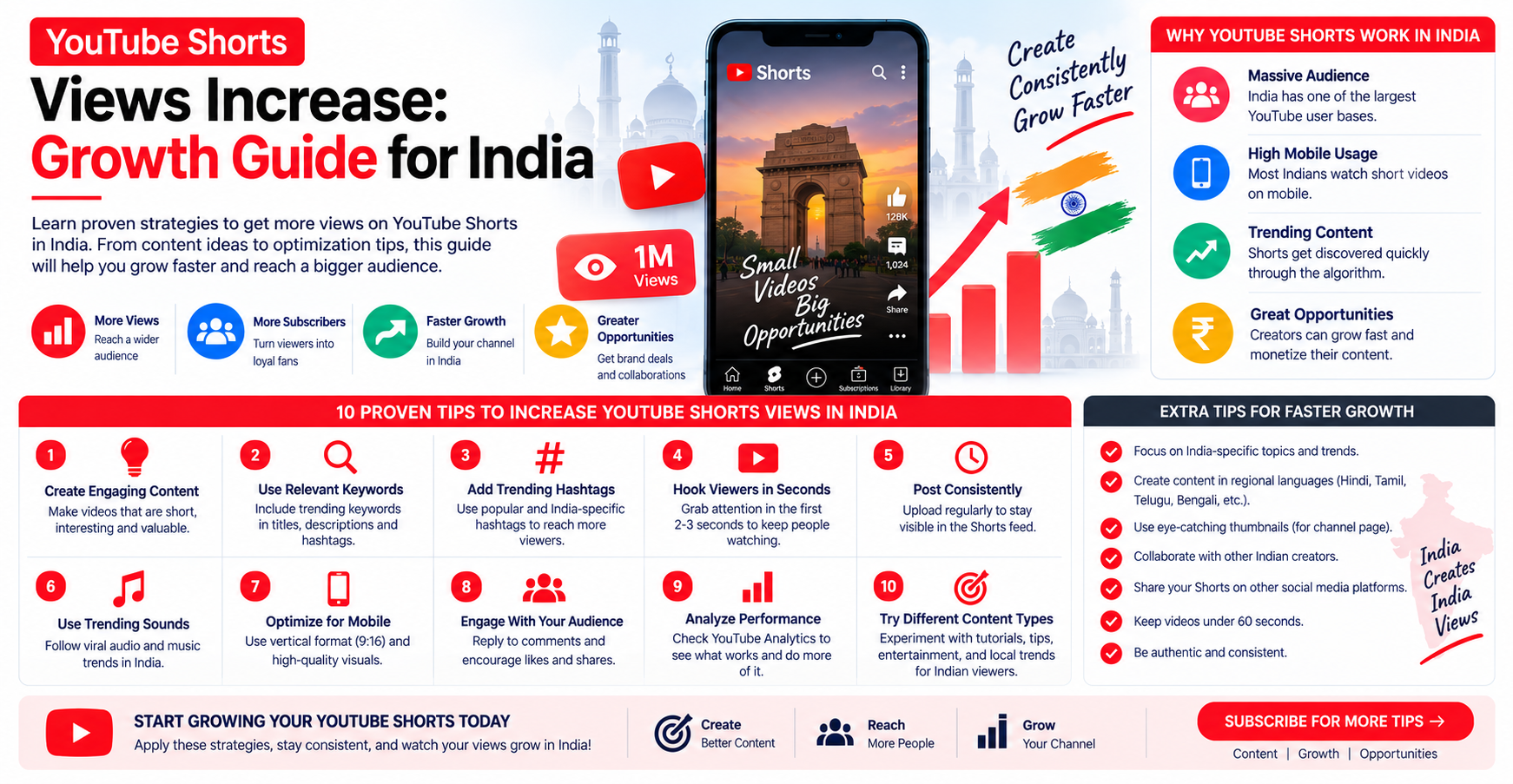
Getting more views on YouTube Shorts can be frustrating. You spend time filming, editing, adding captions, and choosing a topic. Then the Short gets a few hundred views and stops moving. Meanwhile, another simple video may reach thousands or even millions. So what actually drives a YouTube Shorts views increase? There is no single trick.
More sustainable growth usually comes from improving several areas together:
- Topic selection
- Opening seconds
- Viewer retention
- Content clarity
- Video length
- Titles and descriptions
- Consistent publishing
- Audience understanding
- YouTube Analytics
- Continuous testing
India also provides creators with an enormous potential YouTube audience. Google’s advertising resources indicated potential YouTube reach of approximately 500 million users in India in late 2025. DataReportal cautions that advertising reach should not automatically be interpreted as monthly active-user count. This guide explains how to get more YouTube Shorts views in India without relying on fake engagement, rigid posting formulas, or unsupported algorithm hacks.
Quick Answer: How to Get More Views on YouTube Shorts
To improve your chances of getting more Shorts views:
- Choose topics your audience already cares about.
- Make the opening immediately understandable.
- Remove unnecessary pauses and introductions.
- Keep the Short only as long as the idea requires.
- Use readable captions and on-screen text when useful.
- Write clear titles that describe the topic.
- Publish consistently at a sustainable rate.
- Review Shorts analytics regularly.
- Study which videos attract engaged viewers.
- Repeat successful topics and formats.
Do not expect every Short to perform equally. The goal is to improve your overall performance over time rather than chase one viral video.
What a YouTube Shorts Views Increase Really Means
A higher public view count is useful, but creators should understand how YouTube now counts Shorts views.
Shorts View Counting Changed in March 2025
Starting 31 March 2025, YouTube changed how Shorts views are counted. A view is counted when a Short starts to play or replay, with no minimum watch-time requirement. YouTube kept the previous Shorts measurement as a separate metric called Engaged views, which measures viewers who chose to continue watching beyond the initial seconds.
In August 2026, YouTube also standardized start-to-play view counting across other video formats, while revenue and YPP eligibility continue to rely on qualified or engaged viewing measures. For creators, this means you should not evaluate Shorts performance from public views alone.
Metrics That Matter Alongside Views
Inside YouTube Analytics, useful Shorts metrics include:
- Engaged views
- Stayed to watch
- Swiped away
- Average view duration
- Average percentage viewed
- Watch time
- Subscribers gained
- Traffic sources
YouTube defines Stayed to watch as the percentage of times viewers watched a Short rather than swiping away.
A meaningful YouTube Shorts views increase should ideally come with stronger viewer behaviour, not just a higher public counter.
Why Are Your YouTube Shorts Not Getting Views?
There is no single reason.
Common problems include:
- Weak opening
- Slow introduction
- Unclear topic
- Poor framing
- Unnecessary length
- Content that does not match the audience
- Repetitive ideas
- Inconsistent channel positioning
- Low viewer interest in the topic
Avoid assuming that a low-performing Short means your channel has been “shadowbanned.” Start by examining the video itself and your Analytics data.
Check Viewed vs. Swiped Away
YouTube Studio provides a How many chose to view report for Shorts.
It shows the percentage of times viewers:
- Watched
- Swiped away
If many viewers immediately swipe away, investigate:
- Opening visual
- First spoken sentence
- Topic clarity
- On-screen text
- Whether the payoff takes too long
Do not rely on a universal percentage such as “60% is good.” Compare your videos against your own channel history.
Check Average View Duration
Average view duration tells you how long engaged viewers stayed. For Shorts, YouTube calculates this using engaged views and their watch time.
If viewers leave early, look for:
- Long pauses
- Repetition
- Irrelevant context
- Delayed payoff
- Sections that could be shortened
How the YouTube Shorts Recommendation System Works
YouTube does not publish a simple formula that creators can follow to guarantee Shorts distribution.
Avoid claims such as:
- Completion rate has a fixed weight
- Likes have a fixed algorithm percentage
- A specific retention number guarantees viral reach
- Every Short is tested on an identical small audience
Instead, focus on what YouTube actually exposes through Analytics:
- Whether viewers chose to watch
- How long they watched
- Whether they engaged
- Whether the content attracted subscribers
- Where viewers discovered it
Use these signals to understand audience response rather than trying to reverse-engineer a secret score.
Create a Strong Opening
The beginning of a Short matters because viewers can swipe away quickly.
Your opening should answer one question:
Why should someone keep watching?
Skip Long Introductions
Instead of:
“Hello guys, welcome back to another video…”
start with the topic.
Examples:
- “This ₹50 breakfast in Delhi surprised me.”
- “Three mistakes killing your Shorts views.”
- “Before buying this phone, check this.”
- “Here’s what ₹500 gets you in Jaipur.”
- “I tested this editing trick for seven days.”
Keep the hook accurate. Misleading clickbait may create a view but damage viewer satisfaction.
Use Visual Context Immediately
A hook can also be visual.
Consider showing:
- The finished result
- Product close-up
- Before-and-after
- Interesting location
- Demonstration already in progress
- Clear on-screen headline
Viewers should understand the topic without waiting through unnecessary setup.
Improve YouTube Shorts Retention
Retention is not about making every video extremely fast. It is about removing sections that do not contribute anything useful.
Remove Unnecessary Seconds
During editing, ask:
Does this second add information, emotion, context, or entertainment?
If not, consider removing it.
Common sections to trim include:
- Long pauses
- Repeated explanations
- Logo animations
- Greetings
- Walking toward the camera
- Unnecessary transitions
Keep the Story Moving
A Short should continue giving viewers a reason to stay.
That can happen through:
- New information
- Visual changes
- Demonstrations
- Story progression
- Questions
- Examples
- Results
Do not add visual effects every two seconds simply because a generic guide says you should. Editing should support the content rather than distract from it.
Use Rewatchable Content Naturally
Some videos naturally encourage rewatching.
Examples include:
- Recipes
- Tutorials
- Fast lists
- Demonstrations
- Before-and-after videos
- Detailed visual examples
Do not artificially design confusing loops simply to inflate replay behaviour. Make the content worth watching again.
Choose Better YouTube Shorts Topics
- Strong editing cannot always rescue a topic people do not care about.
- Before filming, research whether the audience has an existing interest.
Use YouTube Search Suggestions
Type your topic into YouTube Search and review autocomplete suggestions. These can reveal common searches.
For example:
Instead of:
Phone tips
you might discover more specific topics such as:
- Best phone under ₹15,000
- Android battery-saving tips
- WhatsApp privacy settings
- Phone camera tricks
Specific topics are often easier for viewers to understand.
Use Customer and Viewer Questions
Comments can become content ideas.
If viewers repeatedly ask:
- Which product?
- How much?
- Where?
- How?
- Which option is better?
turn those questions into Shorts. This creates content around genuine audience demand.
Build Repeatable Content Series
Series make future content easier to plan.
Examples:
- ₹100 Street Food Challenge
- One SEO Tip a Day
- Smartphone Trick of the Week
- Delhi Café Review Series
- 30 Days of Graphic Design Tips
- One Finance Concept in 60 Seconds
A viewer who enjoys one part has an obvious reason to explore other episodes.
YouTube Shorts SEO
Shorts can also appear across YouTube search and other discovery surfaces. SEO should help YouTube and viewers understand the content. It should not become keyword stuffing.
Write Clear Shorts Titles
A useful title should communicate the actual topic.
For example:
How to Increase YouTube Shorts Views in India
is clearer than:
OMG THIS WORKED
You can include important phrases naturally, such as:
- YouTube Shorts views increase
- How to get more YouTube Shorts views
- YouTube Shorts tips
- YouTube Shorts SEO
- YouTube Shorts India
Use whichever phrase accurately describes the video.
Use Relevant Hashtags
There is no official rule saying creators need exactly:
- 2 hashtags
- 3 hashtags
- 5 hashtags
Use relevant hashtags where they genuinely improve context. Avoid filling descriptions with unrelated trending tags.
Add Captions and On-Screen Text
Captions can help viewers understand videos in situations where they cannot or do not want to use audio. Text overlays can also make key information clearer.
Use:
- Readable font size
- Good contrast
- Short phrases
- Accurate spelling
Do not cover important visual elements with text.
How Long Should a YouTube Short Be?
YouTube Shorts can be up to three minutes long for eligible square or vertical uploads. But that does not mean every Short should be three minutes.
There is no universal “best length.”
The correct duration depends on the idea.
Short Videos Work Well When
The content is:
- A quick joke
- Simple reveal
- Short demonstration
- One fact
- One tip
- Reaction
Longer Shorts Work Well When
The content needs:
- A tutorial
- Story
- Explanation
- Comparison
- Demonstration
- Step-by-step context
Use only as much time as the idea needs.
Important Copyright Note for Longer Shorts
YouTube says most songs available through the Shorts Audio Library can be used for up to 90 seconds in a three-minute Short, though some tracks have shorter limits. Royalty-free music from YouTube’s Audio Library can also be used.
Also note that Shorts longer than one minute with an active Content ID claim can be blocked globally. So the original claim that “copyrighted music automatically limits every Short to 60 seconds” is too broad.
How Often Should You Post YouTube Shorts?
There is no official posting frequency that guarantees growth.
You do not need to publish:
- Exactly 3 times per week
- Exactly 5 times per week
- Every day
Choose a sustainable schedule that allows you to maintain useful content.
For example:
- Several Shorts each week
- Daily if quality remains strong
- Batch production followed by scheduled publishing
Consistency matters because it gives you more opportunities to learn what your viewers want. But quantity should not replace quality.
Best Time to Post YouTube Shorts in India
There is no universal India-wide best time.
An audience of students may behave differently from:
- Working professionals
- Parents
- Business owners
- Overseas Indians
Instead of relying on a generic “6 PM–9 PM” rule:
- Publish at different reasonable times.
- Review YouTube Analytics.
- Identify when your audience is active.
- Compare results.
- Adjust your schedule.
Your own audience data is more useful than a general India posting-time chart.
Turn Long-Form Videos Into Shorts
If you already create longer YouTube videos, repurposing useful moments can improve production efficiency.
Look for moments such as:
- Strong answers
- Important tips
- Surprising statements
- Demonstrations
- Results
- Frequently asked questions
Make Each Short Stand Alone
- Do not assume viewers watched the original video.
- Add enough context for the clip to make sense independently.
Connect Shorts With Related Videos
- YouTube allows creators to attach a related video to a Short.
- This can help interested viewers discover longer videos on the same topic.
- Use Shorts for discovery and long-form content for deeper explanation when appropriate.
Use Calls to Action Carefully
You do not need a long:
“Like, comment, share, subscribe, hit the bell…”
speech in every Short.
Choose one relevant next step.
Examples:
- Subscribe for part two.
- Comment which one you prefer.
- Watch the full guide.
- Check the related video.
Keep the content itself as the priority.
Use AI to Improve Your Shorts Workflow
AI can help creators work faster, but it should not replace judgment.
Use AI for Ideas
AI can help generate:
- Topic angles
- Video ideas
- Frequently asked questions
- Series concepts
- Alternative hooks
Then choose ideas based on actual audience relevance.
Use AI for Hook Variations
If you already have a topic, AI can help brainstorm several opening lines. Rewrite the final version in your own voice.
Use AI for Captions
Automatic transcription can speed up caption creation.
Review:
- Hindi
- Hinglish
- Regional names
- Brand names
- Technical terms
because automated transcription can make errors.
Use AI for Repurposing
AI clipping tools can identify potential moments in long videos. Treat their suggestions as a starting point.
Human judgment is still important for:
- Context
- Emotion
- Pacing
- Accuracy
Analyze Your YouTube Shorts Performance
Analytics should guide what you make next.
YouTube provides Shorts-specific metrics including:
- Shown in feed
- How many chose to view
- Subscribers
- Traffic sources
- Engaged views
- Average view duration
- Average percentage viewed
Compare Your Best and Worst Shorts
Ask:
- Did they cover different topics?
- Was the opening different?
- Was one much longer?
- Was one easier to understand?
- Did one attract more subscribers?
- Did one receive more search traffic?
Look for repeated patterns rather than one-off anomalies.
Avoid Universal “Healthy” Benchmarks
Do not assume every Short must achieve:
- 60% stayed to watch
- 70% average viewed
- 30 likes per 1,000 views
- A fixed subscriber conversion
Performance varies dramatically according to:
- Length
- Niche
- Audience
- Topic
- Channel stage
Use your own historical performance as the main benchmark.
YouTube Shorts Growth in India
India’s large and multilingual audience gives creators several opportunities. Google’s advertising resources indicated YouTube potential reach of around 500 million people in India in late 2025.
Creators can experiment with:
- Hindi
- English
- Hinglish
- Bengali
- Tamil
- Telugu
- Marathi
- Malayalam
- Other regional languages
Language choice should follow your actual audience.
Use Local Specificity
Specific information can make content more useful.
Instead of:
Cheap restaurant
try:
Dinner for two under ₹500 in Pune
Instead of:
Phone tips
try:
3 Android battery settings to change today
Specificity improves clarity.
Use Indian Events When Relevant
Content opportunities may include:
- Festivals
- Cricket
- Exams
- Ecommerce sales
- Local events
- Product launches
Do not force a trending event into a niche where it does not belong.
Avoid Fake YouTube Shorts Views
YouTube explicitly excludes artificial or fake Shorts views from eligible monetization. Its monetization policy lists automated click or scroll bots as examples of ineligible Shorts views. YouTube also prohibits fake engagement more broadly.
Buying artificial views can:
- Distort analytics
- Fail to create genuine viewers
- Create monetization problems
- Waste marketing spend
For sustainable growth, focus on real audience behaviour.
YouTube Partner Program Requirements in 2026
As of September 2026, YouTube’s standard full YPP eligibility route remains:
- 1,000 subscribers + 4,000 qualified public watch hours in the previous 12 months
or:
- 1,000 subscribers + 10 million qualified public Shorts views in the previous 90 days
Watch hours generated from the Shorts Feed do not count toward the 4,000-watch-hour route.
YouTube Partner Program Changes Coming in 2027
This part of the original article was directionally correct, but it needs more precise wording. YouTube has officially announced changes beginning 1 February 2027.
For new creators seeking ads and Premium revenue sharing, the entry threshold will become:
- 1,000 subscribers + 8,000 qualified watch hours in the previous 365 days
or:
- 1,000 subscribers + 20 million qualified Shorts views in the previous 90 days
Existing YPP members will not lose their membership simply because these new entry thresholds increase.
Shorts Revenue Requirement From February 2027
- YouTube is also changing Shorts earnings.
- Beginning 1 February 2027, creators will need to maintain:
- 10 million qualified Shorts views over the previous 90 days
- to earn ads and Premium revenue from the Shorts Creator Pool.
- If an existing YPP creator falls below that Shorts threshold, the channel will not automatically be removed from YPP, and other qualifying revenue streams can continue.
Earlier Monetization Features Remain Available
YouTube says eligibility requirements for:
- Fan funding
- YouTube Creator Partnerships
- YouTube Shopping
will remain available at earlier thresholds for eligible creators.
These include:
- 500 subscribers
- Plus either 3,000 qualified watch hours in the previous year
- Or 3 million qualified Shorts views in the previous 90 days
along with YouTube’s other eligibility conditions.
Common YouTube Shorts Mistakes
Slow Openings
Get to the point quickly.
Random Topics
Experiment, but maintain enough consistency that viewers understand your channel.
Overusing Hashtags
- Relevant hashtags are enough.
- Do not turn the description into a keyword wall.
Publishing Only for Quantity
More videos do not automatically mean more views.
Ignoring Analytics
Use actual audience behaviour to improve future Shorts.
Buying Fake Views
Artificial activity does not create a genuine audience and can create monetization and policy problems.
Reposting Without Adding Value
YouTube’s Shorts monetization policy identifies non-original content such as unedited reuploads from other platforms as potentially ineligible for revenue sharing.
If repurposing your own content:
- Use a clean source file.
- Re-edit for YouTube.
- Add context where needed.
- Ensure you have rights to all material.
Frequently Asked Questions About YouTube Shorts Views
How Do I Get More Views on YouTube Shorts?
Focus on:
- Better topics
- Clear openings
- Strong viewer retention
- Useful titles
- Consistency
- Analytics
Do not rely on one algorithm trick.
Why Are My YouTube Shorts Not Getting Views?
Possible reasons include:
- Weak topic
- Low viewer interest
- High swipe-away behaviour
- Slow opening
- Confusing content
- Poor audience fit
Check YouTube Analytics before making assumptions.
How Long Should a YouTube Short Be?
- YouTube allows Shorts up to three minutes.
- Use the shortest duration that fully delivers the idea.
- There is no universal 20–60-second rule.
How Often Should I Post YouTube Shorts?
- There is no official perfect frequency.
- Choose a schedule that allows you to publish consistently without sacrificing quality.
What Is the Best Time to Post YouTube Shorts in India?
- There is no universal best time.
- Use your own YouTube Analytics and audience behaviour.
Do Hashtags Help YouTube Shorts Get Views?
- Relevant hashtags can provide additional topic context, but they cannot compensate for weak content.
- Avoid arbitrary hashtag formulas.
Can a New Channel Get YouTube Shorts Views?
Yes.
Shorts can help channels reach viewers beyond their existing subscriber base. New channels should focus on clear topics and audience response rather than assuming subscriber count alone controls distribution.
Should I Delete a Short That Performs Poorly?
Do not automatically delete a Short simply because it performs slowly at first.
Evaluate whether there is another reason to remove it, such as:
- Incorrect information
- Copyright issue
- Brand problem
- Duplicate upload
Otherwise, use the performance data to improve your next video.
Do Fake Views Help YouTube Shorts?
No sustainable benefit comes from fake views. Artificial or automated Shorts views are not eligible for monetization and can create inaccurate performance data.
Final Thoughts on Increasing YouTube Shorts Views
A sustainable YouTube Shorts views increase comes from improving what real viewers experience.
Start with the fundamentals:
- Choose relevant topics.
- Make the opening clear.
- Remove unnecessary seconds.
- Create content worth finishing.
- Use searchable, accurate titles.
- Publish consistently.
- Study engaged views and viewer behaviour.
- Repeat what works.
- Avoid artificial engagement.
India gives creators access to one of YouTube’s largest potential audiences, with around 500 million people in Google’s potential ad-reach data in late 2025. But audience size alone does not guarantee views.
The creators most likely to grow are the ones who consistently learn from their audience and improve the next Short.