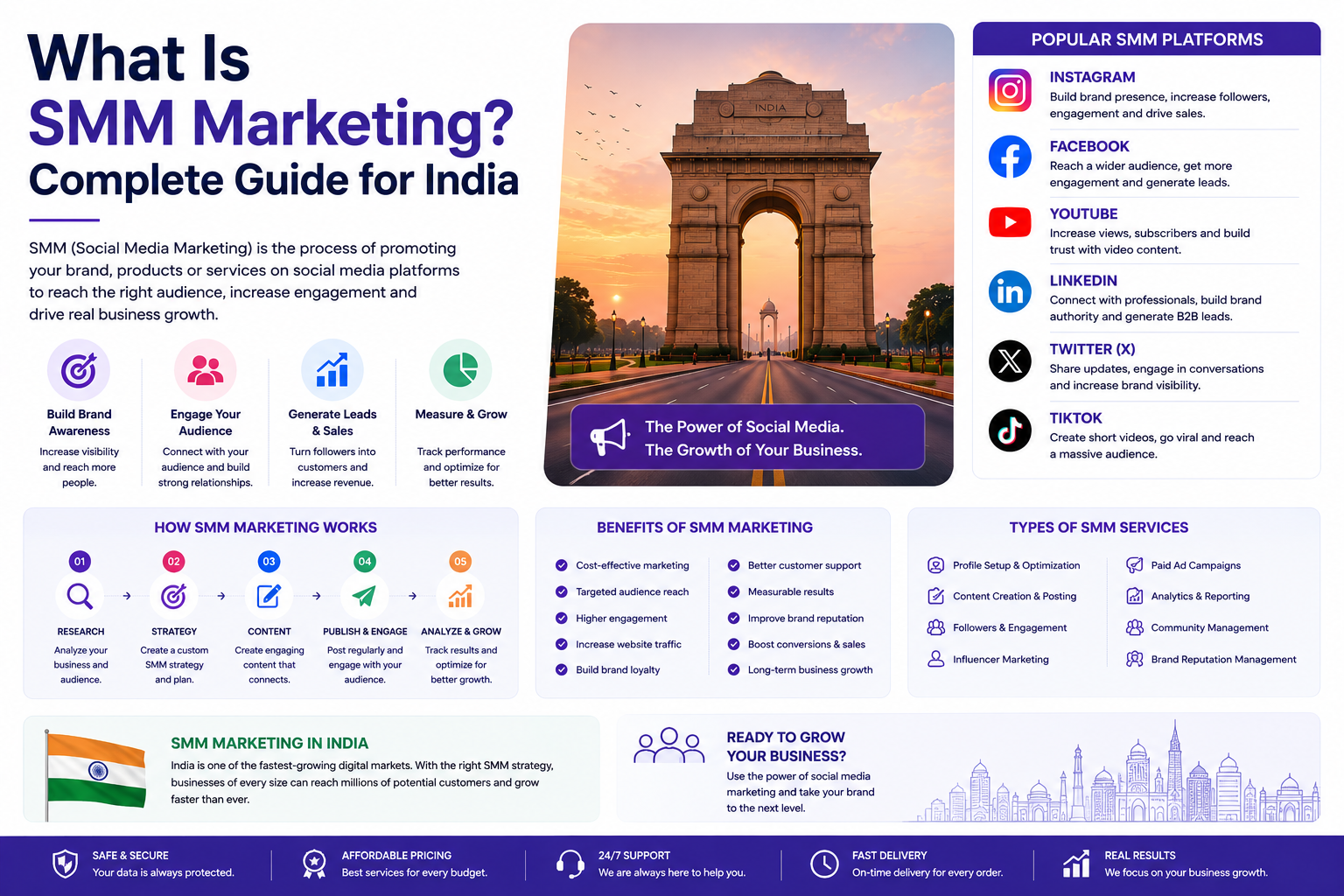
What Is SMM Marketing? Complete Guide to Social Media Growth in India
Someone on your team has probably already said, “We need to be on social media.” That makes sense. But what does that actually mean for a business? Which platforms should you use? What should you post? Should you run ads? How do you measure whether any of it is producing results?
That is where SMM marketing comes in. India has one of the world’s largest digital audiences. DataReportal’s Digital 2026 India report estimates that India had 500 million active social media user identities in October 2025, along with approximately 1.03 billion internet users. Social media user identities represented 34.1% of the country’s population. DataReportal also cautions that these identities should not automatically be interpreted as 500 million unique individuals.
For Indian businesses, that creates a huge opportunity to reach customers through content, conversations, advertising, creators, and online communities. This guide explains what SMM marketing is, how it works, its main types, benefits, platforms, strategies, costs, metrics, and how businesses in India can use it effectively.
What Is SMM Marketing?
SMM marketing stands for social media marketing. It means using social media platforms to promote a brand, communicate with customers, build an audience, generate leads, and support business goals.
Common platforms include:
- YouTube
- X
- Snapchat
- Other relevant social communities
SMM can be as simple as publishing one helpful post or as detailed as running a multi-platform advertising campaign. But effective social media marketing involves more than uploading photos and hoping people respond.
A complete social media marketing strategy may include:
- Audience research
- Platform selection
- Content planning
- Content creation
- Community management
- Paid advertising
- Creator partnerships
- Analytics
- Campaign optimization
The goal is to turn social media activity into useful business outcomes.
Why Is SMM Marketing Important for Businesses?
Social media gives businesses direct access to a large digital audience.
DataReportal estimates that India had:
- 1.03 billion internet users
- 500 million social media user identities
- 1.06 billion cellular mobile connections
in late 2025.
This means potential customers are already using digital platforms to:
- Discover products
- Compare businesses
- Watch reviews
- Search for information
- Follow creators
- Ask questions
- Communicate with brands
- Make purchasing decisions
SMM marketing gives businesses opportunities to participate in those moments.
Build Online Visibility
Regular, useful content can help more people discover and recognize your brand. A local business in Jaipur, a fashion brand in Delhi, or a software company in Bengaluru can all use social media differently while working toward the same basic goal: becoming more visible to the right audience.
Build Customer Trust
Social media also allows potential customers to see:
- Reviews
- Comments
- Customer experiences
- Product demonstrations
- Brand responses
- Educational content
Together, these can help customers understand a business before contacting or buying from it.
Support Business Results
Social media can contribute to:
- Website traffic
- Messages
- Leads
- Bookings
- App downloads
- Sales
However, results depend on the strategy, audience, content, offer, and execution. SMM should not be measured only by followers and likes.
How Does SMM Marketing Work?
SMM marketing works as a continuous process rather than a one-time campaign.
A simple framework looks like this:
Goal → Audience → Platform → Content → Engagement → Measurement → Improvement
Then the cycle repeats.
Set Clear SMM Marketing Goals
Decide what you want social media to achieve before creating content.
Possible goals include:
- Brand awareness
- Audience growth
- Website traffic
- Customer enquiries
- Lead generation
- Sales
- App installs
- Community building
- Customer support
Avoid goals that are too vague.
Instead of:
Grow on social media.
use something measurable, such as:
Generate more qualified enquiries from Instagram during the next quarter.
The exact target should reflect your current performance and business capacity.
Identify Your Target Audience
Do not create content for “everyone in India.”
India contains different:
- Languages
- Cities
- Regions
- Income groups
- Age groups
- Interests
- Buying behaviours
A beauty brand targeting young consumers in Mumbai may need a completely different approach from a B2B software company targeting founders in Bengaluru.
Build a simple buyer persona around factors such as:
- Location
- Language
- Age
- Occupation
- Problem
- Goal
- Buying motivation
- Preferred content format
The clearer your audience becomes, the easier content planning becomes.
Choose the Right Social Media Platforms
Not every business needs every platform. Choose platforms based on where your customers can actually be reached.
For example:
B2B and professional services
- YouTube
- Facebook where relevant
Fashion, food, beauty, and lifestyle
- YouTube
Local businesses
- YouTube where appropriate
Educational brands
- YouTube
- LinkedIn depending on the audience
Choose based on evidence, not personal preference.
Create a Social Media Content Strategy
A social media content strategy defines:
- What you publish
- Who it is for
- Why you publish it
- Which formats you use
- Which business objective it supports
Your content mix may include:
- Educational posts
- Tutorials
- Product demonstrations
- Customer stories
- Entertainment
- Industry insights
- Offers
- Behind-the-scenes content
Indian businesses can also create content around relevant:
- Festivals
- Regional events
- Seasonal behaviour
- Cultural moments
- Industry events
Use cultural references naturally rather than forcing them into every post.
Publish and Promote Relevant Content
There is no universal “best posting time” for every Indian audience. Instead of assuming evenings or weekends always perform best, review your own platform analytics.
Test:
- Days
- Times
- Formats
- Topics
- Creative styles
You can also repurpose a strong idea across multiple channels.
For example, one useful video might become:
- An Instagram Reel
- A YouTube Short
- A LinkedIn post
- A WhatsApp update where appropriate
- A website article
Adapt the format instead of copying exactly the same post everywhere.
Engage With Your Audience
Social media is designed for interaction.
Reply to useful:
- Comments
- Questions
- Messages
- Customer concerns
Depending on your audience, communication may use:
- English
- Hindi
- Hinglish
- Bengali
- Marathi
- Tamil
- Telugu
- Other regional languages
The goal is not to sound informal at all costs. The goal is to communicate naturally with the people you want to reach.
Track Results and Optimize Campaigns
Use analytics instead of assumptions.
Depending on your objective, monitor:
- Reach
- Impressions
- Views
- Engagement
- Watch time
- Website clicks
- Leads
- Purchases
- Cost per result
- Return on ad spend
Do not assume one format is permanently better because it won one week. Look for patterns across enough content to make a useful decision.
What Are the Main Types of SMM Marketing?
SMM marketing includes several different approaches. Most businesses use a combination rather than relying completely on one.
Organic Social Media Marketing
Organic social media marketing means publishing and interacting without paying the platform specifically to distribute each post as an advertisement.
It may include:
- Posts
- Reels
- Videos
- Stories
- Community discussions
- Replies
Organic marketing can support:
- Brand awareness
- Community
- Customer relationships
- Long-term content discovery
It still requires resources such as staff time, content production, and creative work, so “organic” does not necessarily mean completely free. There is also no universal timeline for organic growth. Results vary by audience, platform, competition, brand recognition, and content quality.
Paid Social Media Advertising
Paid social advertising lets businesses pay platforms to distribute advertisements to selected audiences.
Campaigns may be optimized around objectives such as:
- Awareness
- Traffic
- Leads
- App activity
- Sales
Paid campaigns can provide additional reach and measurement, but results are not guaranteed simply because money is being spent.
Performance still depends on:
- Audience
- Creative
- Offer
- Landing page
- Tracking
- Campaign setup
Paid and organic social media can work together rather than competing with each other.
Influencer Marketing
Influencer marketing involves working with creators who already have an audience. The largest creator is not automatically the best partner.
Evaluate:
- Audience relevance
- Location
- Language
- Engagement quality
- Content quality
- Brand fit
- Previous partnerships
Indian brands and creators should also follow applicable advertising disclosure requirements. ASCI’s influencer guidance requires promotional influencer content with a material connection to use clear advertising disclosure labels.
Social Media Content Marketing
Content marketing focuses on publishing something useful enough that people choose to consume it.
Examples include:
- Tutorials
- Guides
- Comparisons
- Industry insights
- Product education
- Behind-the-scenes content
- Entertaining posts
The objective is not to turn every post into a direct sales pitch. Useful content can help an audience become more familiar with the brand before they are ready to purchase.
Community Management
Community management involves maintaining conversations around a brand.
This may include:
- Replying to comments
- Answering messages
- Moderating groups
- Managing customer discussions
- Collecting feedback
For some Indian businesses, customer communities may also exist through WhatsApp or other messaging platforms. Good community management helps a business listen as well as publish.
User-Generated Content
User-generated content, or UGC, includes content created by customers or users rather than the brand’s internal marketing team.
Examples include:
- Customer photos
- Reviews
- Videos
- Testimonials
- Product demonstrations
With appropriate permission, businesses can use genuine customer content as part of their wider content strategy. Avoid inventing testimonials or customer experiences.
Social Commerce
Social commerce connects social discovery with purchasing. Depending on the platform and available features, customers may discover products through social content and then move toward:
- Product pages
- Business messages
- Catalogues
- Ecommerce websites
- Platform-supported shopping tools
For many Indian businesses, messaging platforms such as WhatsApp can also support product discovery, enquiries, and customer communication.
What Are the Benefits of SMM Marketing?
Social media marketing can support several business objectives.
Increase Brand Awareness
Every useful piece of content creates another opportunity for someone to discover your brand. Repeated relevant exposure can gradually improve brand recognition.
Improve Customer Engagement
Social media creates two-way communication.
Customers can:
- Comment
- Reply
- Ask questions
- Share opinions
- Send messages
These interactions can help a business better understand its audience.
Drive Website Traffic
Social platforms can direct interested people toward:
- Product pages
- Service pages
- Articles
- Landing pages
- Booking forms
Use tracked links when possible so traffic can be measured accurately. Do not assume social traffic is automatically cheaper than paid search traffic. Costs and quality vary by business and campaign.
Generate Leads and Sales
A clear call to action can move users toward:
- Enquiries
- Forms
- Calls
- Messages
- Purchases
The social platform may create attention, while the offer and sales process determine whether that attention converts.
Build Customer Loyalty
Businesses can stay connected with existing customers through:
- Helpful content
- Support
- New product information
- Community conversations
- Customer stories
Retention should be part of the social strategy, not only acquisition.
Improve Brand Credibility
A complete and active social presence can help customers learn more about a business.
Credibility can be supported by:
- Reviews
- Genuine customer experiences
- Clear business information
- Helpful responses
- Useful content
Follower count alone does not establish credibility.
Gain Market Insights
Social conversations can reveal:
- Customer questions
- Objections
- Interests
- Complaints
- Product ideas
- Content opportunities
This can complement more formal market research.
Measure Marketing Performance
Digital social campaigns can provide measurable information such as:
- Clicks
- Leads
- Purchases
- Cost per result
- Return on ad spend
This does not mean social media automatically generates a higher ROI than television, print, search, or other channels. Compare performance using your own business data.
Which Social Media Platforms Are Best for SMM Marketing in India?
India’s largest platforms have very different audiences and uses. Platform figures should also be interpreted carefully because companies often report advertising reach rather than monthly active users.
YouTube
Google’s advertising resources indicated potential YouTube reach of approximately 500 million users in India in late 2025. DataReportal notes that advertising reach should not automatically be treated as monthly active users.
Useful for:
- Tutorials
- Reviews
- Long-form content
- Shorts
- Product demonstrations
- Educational content
Meta’s advertising tools indicated potential Instagram reach of approximately 481 million users in India in late 2025.
Useful for:
- D2C brands
- Fashion
- Food
- Beauty
- Lifestyle
- Creators
- Visual storytelling
Use Reels, Stories, photos, and carousels based on actual audience performance. There is no universal rule saying Reels always outperform every other format.
Meta’s advertising tools indicated potential Facebook reach of approximately 403 million users in India in late 2025. Meta emphasizes that advertising audience size is not equivalent to monthly or daily active users.
Useful for:
- Local businesses
- Communities
- Broad consumer audiences
- Customer communication
- Advertising
LinkedIn’s advertising resources reported approximately 170 million registered members in India in late 2025. Registered members should not be directly compared with active-user or advertising-reach figures from other platforms.
Useful for:
- B2B
- Recruitment
- Professional services
- Business networking
- Thought leadership
Snapchat
Snap’s advertising tools indicated potential reach of approximately 213 million users in India in late 2025. It may be worth testing for businesses whose audience and creative style fit the platform.
X
X’s advertising resources indicated potential reach of approximately 22.2 million users in India in late 2025. DataReportal advises caution when interpreting X’s audience figures because the platform’s reported numbers can fluctuate considerably.
Useful for:
- News
- Commentary
- Customer communication
- Real-time discussions
- Industry conversations
TikTok
TikTok remains blocked in India. In August 2025, TikTok confirmed that it had not restored access in India, while an Indian IT Ministry official said the government had not revoked the ban. More recent reporting available in 2026 continues to list India as having a nationwide TikTok ban.
India-focused businesses should therefore use officially available alternatives for short form video, such as:
- Instagram Reels
- YouTube Shorts
- Facebook Reels
How to Create an Effective SMM Marketing Strategy?
A practical SMM strategy can follow ten steps.
Step 1: Define Your Marketing Goals
Choose measurable business objectives.
Step 2: Research Your Target Audience
Understand location, language, interests, problems, and buying behaviour.
Step 3: Analyze Your Competitors
Study:
- Platforms
- Content
- Offers
- Customer comments
- Positioning
Look for gaps instead of copying.
Step 4: Select the Right Social Media Channels
Focus resources where relevant customers can actually be reached.
Step 5: Build a Content Calendar
Plan around:
- Campaigns
- Product launches
- Festivals
- Events
- Evergreen topics
Step 6: Create High-Quality Content
Create content that is:
- Useful
- Clear
- Relevant
- Easy to consume
Step 7: Use Paid Advertising When Appropriate
Paid ads can support specific goals when targeting, creative, tracking, and budget are properly managed.
Step 8: Build and Manage Your Community
Respond, listen, and maintain genuine conversations.
Step 9: Measure Social Media Performance
Track KPIs related to your business goals.
Step 10: Optimize Your Strategy
Use performance data to adjust:
- Topics
- Formats
- Creative
- Audiences
- Budget
- Calls to action
Social strategy should continue evolving rather than being created once and forgotten.
What Types of Social Media Content Work Best?
There is no single format that wins for every business. Test formats against your audience.
Short-Form Video
Short-form video is available across several major platforms.
It can work well for:
- Quick tutorials
- Product demonstrations
- Tips
- Behind-the-scenes content
- Short stories
Do not assume algorithms always “push” short-form video harder than every other format.
Measure your own results.
Stories
Stories can support:
- Quick updates
- Polls
- Questions
- Offers
- Behind-the-scenes content
Use them when they fit your audience and platform.
Images and Carousels
Static content can still be useful.
Carousels may work well for:
- Step-by-step guides
- Comparisons
- Lists
- Educational information
Long-Form Video and Livestreams
These formats can provide more space for:
- Product demonstrations
- Interviews
- Q&As
- Tutorials
- Detailed explanations
Use them when the topic requires depth.
Polls, Memes, and Interactive Content
Interactive formats can encourage participation. Humour can also work when it fits your brand. Avoid forcing every cricket, Bollywood, or festival trend into your content simply because it is popular.
User-Generated Content
Customer-created content can add variety and provide genuine social proof when used with appropriate permission.
What Are the Most Important SMM Metrics and KPIs?
You cannot improve what you never measure. Choose KPIs based on your goal.
Reach
Shows how widely content was distributed according to the platform’s definition.
Impressions
Shows how many times content or advertising was displayed.
Engagement
Can include:
- Likes
- Comments
- Shares
- Saves
- Replies
Click-Through Rate
A common formula is:
CTR = (Clicks ÷ Impressions) × 100
Conversion Rate
Measures how many people complete a desired action.
That action could be:
- Purchase
- Registration
- Booking
- Lead
- Download
Follower Growth
Shows how the visible audience changes over time. It should be considered alongside engagement and business results.
Cost Per Result
Shows how much advertising spend is associated with the result being measured.
Return on Ad Spend
A common calculation is:
ROAS = Revenue attributed to ads ÷ Advertising spend
Only use ROAS when revenue tracking is configured reliably. You do not necessarily need to check every metric every week. Review frequency should match your campaign size, spending level, and decision-making needs.
What Are the Common Challenges of SMM Marketing?
Social media marketing requires ongoing management.
Changing Platforms
Features, recommendation systems, advertising tools, and policies continue to evolve.
Increasing Competition
More businesses compete for the same audience attention. Clear positioning becomes increasingly important.
Creating Consistent Content
Small teams may struggle with:
- Ideas
- Design
- Video production
- Approvals
- Publishing
A realistic content calendar can help.
Managing Customer Feedback
Public feedback needs professional handling. Respond calmly and move sensitive customer issues into an appropriate private support channel when necessary.
Measuring Business Results
Connecting social activity to revenue can require:
- Analytics
- UTMs
- Conversion tracking
- CRM data
- Platform pixels or equivalent tools
Maintaining Audience Interest
Audiences change. Continue listening and testing instead of assuming the same content will work forever.
What Are the Most Common SMM Marketing Mistakes?
Focusing Only on Follower Count
A large audience does not automatically create leads or sales.
Posting Without a Strategy
Every post should support a meaningful communication or business objective.
Using the Wrong Platforms
Do not maintain a platform simply because competitors use it.
Ignoring Audience Engagement
Useful customer conversations deserve responses.
Creating Irrelevant Content
Content should connect with the audience you actually want to attract.
Failing to Track Performance
Without measurement, businesses may repeat ineffective tactics for months.
SMM Marketing vs. Digital Marketing: What Is the Difference?
SMM marketing is one part of digital marketing.
SMM Marketing
Focuses primarily on social platforms.
Common goals include:
- Awareness
- Engagement
- Community
- Leads
- Sales
Common channels include:
- YouTube
- Other social platforms
Digital Marketing
Includes a broader range of channels.
These may include:
- SEO
- Paid search
- Websites
- Apps
- Social media
- Display advertising
SMM works best when it supports the wider digital strategy rather than operating in isolation.
How Much Does SMM Marketing Cost in India?
There is no reliable universal monthly price.
Costs vary based on:
- Freelancer vs. agency
- Number of platforms
- Content quantity
- Video production
- Community management
- Paid advertising
- Influencer campaigns
- Strategy
- Reporting
- Industry
- Experience
For that reason, fixed ranges such as ₹8,000, ₹40,000, or ₹1,50,000 should not be presented as standard market prices for every business.
When comparing providers, ask:
- What services are included?
- How many platforms are managed?
- How much content is produced?
- Is video included?
- Is community management included?
- Is ad spend separate?
- Is reporting included?
- Are applicable taxes included in the quote?
Compare scope before comparing price.
How Long Does SMM Marketing Take to Show Results?
There is no universal timeline. Some paid campaigns can begin producing measurable data soon after launch. Organic brand growth may require more time.
The actual timeline depends on:
- Starting audience
- Brand awareness
- Industry
- Competition
- Platform
- Content
- Offer
- Budget
- Campaign objective
Avoid treating:
- 1–2 months
- 3–6 months
- 6–12 months
as guaranteed stages of social media growth. Instead, set a testing period, establish a baseline, and review whether relevant metrics are improving.
SMM Marketing for Small Businesses: Is It Worth It?
SMM marketing can be valuable for small businesses when their customers use social platforms.
A small business can start with:
- One primary platform
- A clear audience
- A manageable content schedule
- Genuine customer interaction
- Simple performance tracking
You do not need to launch everywhere immediately. A focused presence that your team can maintain is usually more practical than creating several accounts and leaving most of them inactive.
Examples of SMM Marketing in Practice
You do not need a famous brand case study to understand how SMM works.
Local Restaurant
A restaurant can publish:
- Food videos
- Customer reviews
- Weekend menus
- Behind-the-scenes content
and use social media to encourage reservations or orders.
D2C Fashion Brand
A fashion brand can use:
- Reels
- Styling guides
- Creator collaborations
- Customer photos
to support discovery and product education.
B2B Software Company
A software business might focus on:
- LinkedIn insights
- YouTube tutorials
- Case studies
- Product explainers
to build credibility with professional buyers.
Local Service Business
A dentist, consultant, salon, or repair business could answer common customer questions and show examples of its work. The strategy changes, but the principle remains the same:
Create content that supports a real customer decision.
What Is the Future of SMM Marketing?
Social media marketing will continue evolving. Several areas are likely to remain important.
Short-Form Video
Short videos will continue to be useful across platforms, but businesses should choose formats based on audience behaviour rather than chasing one format exclusively.
AI-Assisted Marketing
AI can support:
- Content ideation
- Drafting
- Editing
- Creative variations
- Analytics
- Advertising optimization
Human review remains important for accuracy, strategy, brand voice, and cultural relevance.
Social Commerce
Social platforms and messaging tools will continue connecting content with product discovery and purchasing.
Regional-Language Content
India’s linguistic diversity creates strong opportunities for localized content. Businesses can create genuinely regional strategies instead of simply translating English campaigns word for word.
Frequently Asked Questions About SMM Marketing
What Does SMM Stand for in Marketing?
SMM stands for social media marketing. It means using social platforms to promote a business, communicate with customers, build an audience, and support marketing goals.
Is SMM Marketing Good for Small Businesses?
It can be. Small businesses can use social media for:
- Local visibility
- Customer communication
- Content marketing
- Leads
- Brand awareness
Results still depend on strategy and execution.
Which Social Media Platform Is Best for SMM Marketing?
There is no universal best platform.
For example:
- Instagram: visual and consumer brands
- Facebook: local businesses and broad communities
- YouTube: tutorials, education, and video
- LinkedIn: B2B and professional audiences
Choose based on your customers.
How Long Does SMM Marketing Take to Work?
There is no fixed timeline. Paid campaigns may begin generating data quickly, while organic audience development can take longer. Measure improvement against your own baseline instead of relying on a guaranteed number of months.
Is SMM Marketing Part of Digital Marketing?
Yes. Social media marketing is one channel within the broader digital marketing field.
What Is the Difference Between SMM and SEO?
SMM focuses on marketing through social platforms. SEO focuses on improving a website’s visibility in organic search results. Businesses can use both as part of the same digital strategy.
What Is the Difference Between SMM and SMO?
SMM, or social media marketing, covers broader marketing activity on social platforms, including organic content and paid campaigns. SMO, or social media optimization, usually refers to improving profiles, content presentation, and other social elements to strengthen organic visibility and usability.
Final Thoughts
SMM marketing is not simply about posting every day or collecting followers. It is a structured approach to using social platforms for meaningful business goals.
India entered 2026 with approximately:
- 500 million social media user identities
- 500 million potential YouTube ad audience
- 481 million potential Instagram ad audience
- 403 million potential Facebook ad audience
- 170 million LinkedIn registered members
The measurements behind these figures differ, so they should not be treated as directly comparable active-user counts. The opportunity is still enormous.
To make the most of it:
- Define your goals.
- Understand your audience.
- Choose the right platforms.
- Create useful content.
- Communicate with customers.
- Use paid advertising strategically.
- Measure business outcomes.
- Keep improving.
That is what effective SMM marketing in India looks like: not chasing every trend, but using social media deliberately to connect the right audience with the right business at the right time.