What Is an SMM Service in India? Social Media Marketing Guide, Strategy & Benefits
Social media has become an important part of how businesses in India build visibility, communicate with customers, promote products, generate leads, and strengthen their online presence. But professional SMM services involve much more than increasing followers or publishing a few posts every week.
A complete SMM service can combine social media strategy, content creation, social media management, community engagement, paid advertising, influencer marketing, analytics, and performance reporting. India offers businesses a particularly large opportunity. DataReportal’s Digital 2026 India report estimates that India had approximately 1.03 billion internet users and 500 million social media user identities in late 2025. DataReportal also cautions that social media user identities should not automatically be interpreted as 500 million unique individuals.
For businesses, the important question is no longer simply whether social media matters.
The real question is how to use it effectively. This guide explains what an SMM service is, how social media marketing works, the best platforms for Indian businesses, different types of SMM services, pricing, content strategies, analytics, influencer rules, and the steps needed to create sustainable social media growth.
Quick Answer: What Is an SMM Service?
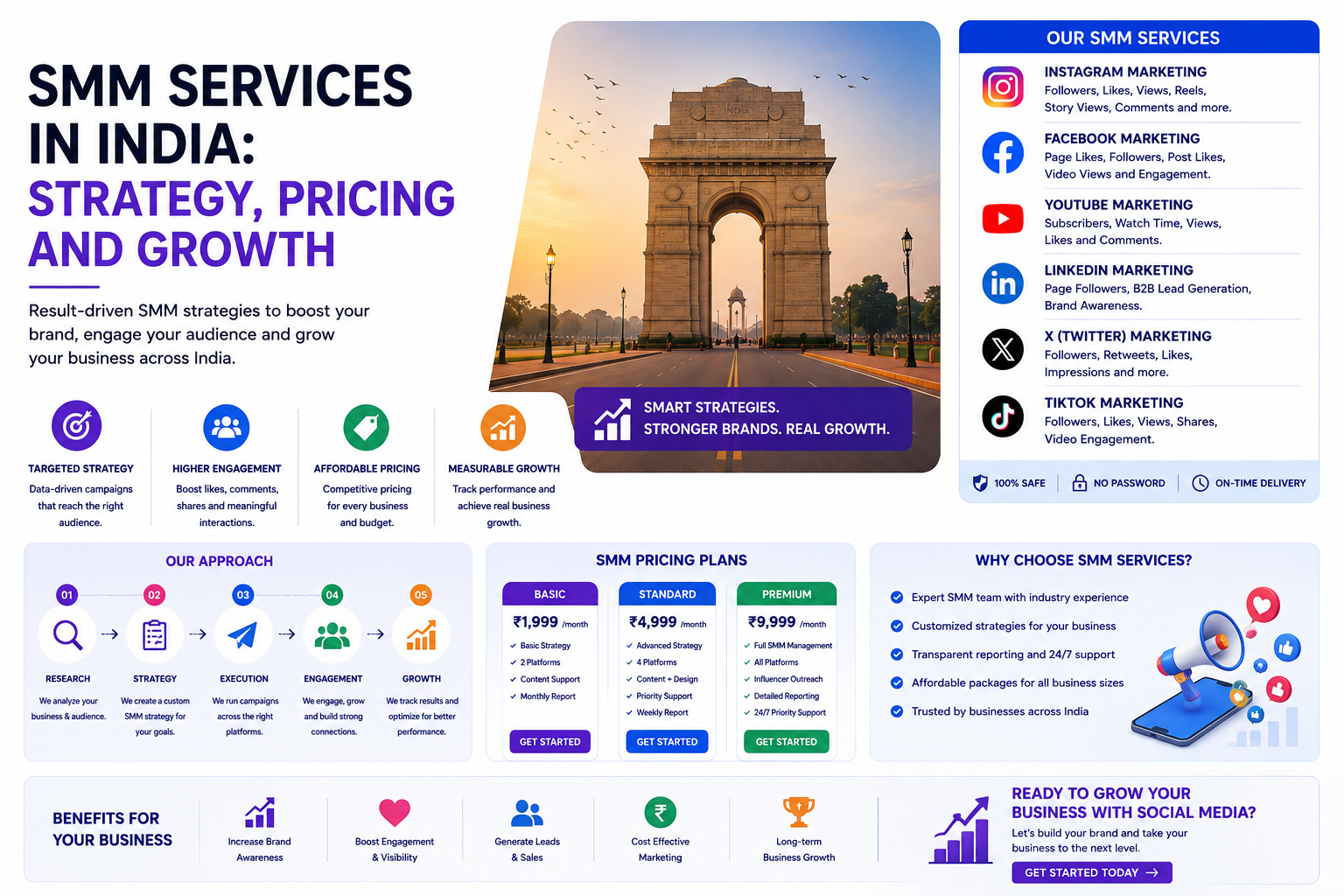
An SMM service is a professional service that helps a business plan, create, publish, promote, manage, and measure content across social media platforms. Depending on the provider and package, SMM services may include social media strategy, account management, graphic design, video creation, publishing, community management, advertising, influencer campaigns, social media analytics, and reporting.
The right service depends on the business.A local restaurant may mainly need Instagram and Facebook content management. A B2B company may focus on LinkedIn and YouTube. An ecommerce brand may require content creation, paid ads, influencer campaigns, conversion tracking, and customer engagement across several channels. That is why businesses should evaluate SMM services based on goals and deliverables rather than follower counts alone.
India Social Media Snapshot
India has one of the largest digital audiences in the world. DataReportal’s Digital 2026 India report indicates that late-2025 platform advertising resources reported approximately 500 million potential YouTube ad audience, 481 million potential Instagram ad audience, and 403 million potential Facebook ad audience in India.
LinkedIn reported approximately 170 million registered members, while Snapchat’s advertising resources indicated potential reach of around 213 million. Reddit’s advertising resources reported approximately 30.8 million potential reach, while X reported approximately 22.2 million.
These figures should not be treated as directly comparable monthly active-user numbers because each platform reports audiences differently. For example, LinkedIn reports registered members, while Meta and Google figures generally relate to potential advertising reach. The practical takeaway is simpler: Indian businesses have access to very large audiences across several major social platforms.
What Is SMM?
SMM stands for Social Media Marketing. It means using social media platforms to promote a brand, communicate with customers, build awareness, attract an audience, generate enquiries, and support business growth. SMM can include both organic and paid activity.
Organic social media includes regular posts, Reels, videos, Stories, customer conversations, and community participation.
Paid social media includes advertising campaigns designed to reach selected audiences and achieve goals such as website traffic, leads, app activity, or sales. A professional SMM service brings these activities together under one strategy.
How Does Social Media Marketing Work?
Social media marketing works as an ongoing process. First, a business identifies its goals and target audience. Then it chooses suitable platforms, develops a content strategy, publishes relevant content, communicates with customers, promotes selected campaigns where appropriate, and measures the results.
The performance data then helps improve future campaigns. There is no single social-media algorithm that works the same way on Instagram, Facebook, LinkedIn, YouTube, Reddit, and every other platform. Recommendation and advertising systems vary considerably.
For businesses, it is more useful to focus on audience relevance, content quality, customer response, and measurable business outcomes than trying to find one universal algorithm trick.
SMM vs. Traditional Marketing
Traditional marketing and social media marketing both have useful roles. Traditional marketing can include television, radio, print advertising, billboards, events, and other offline channels. Social media marketing provides a different set of capabilities. Businesses can often control audience selection, campaign budget, location, creative, campaign duration, and objectives more directly through social advertising platforms.
Social media also creates two-way communication.
Customers can respond, comment, send messages, ask questions, and share their opinions directly with the business. Traditional media can still provide valuable broad reach. Social media provides additional flexibility, interaction, testing, and digital measurement. The right combination depends on the business.
SMM vs. Digital Marketing
Social media marketing is one part of digital marketing. Digital marketing can also include SEO, Google Ads, email marketing, affiliate marketing, website optimization, content marketing, and other digital channels. For example, a business may use social media to create brand awareness, SEO to attract customers from Google, a website to explain the service, and email or WhatsApp to follow up with leads. SMM works best when it supports the wider marketing strategy rather than operating completely on its own.
Why Are SMM Services Important for Businesses?
Professional SMM services can help businesses organize their social-media activity around clear goals rather than random posting.
Build Brand Awareness and Recognition
Social media gives businesses repeated opportunities to appear in front of potential customers. Consistent content can help customers become familiar with your business name, visual identity, products, services, expertise, and brand personality. Brand recognition usually develops over time. One viral post may create temporary attention, but a consistent and recognizable presence can support longer-term awareness.
Reach a Relevant Target Audience
India is not one single audience. Customers differ by location, age, language, income, interests, buying behaviour, and preferred platforms. A brand targeting professionals in Bengaluru may communicate differently from a clothing company targeting consumers in Jaipur.
Depending on the audience, businesses may use English, Hindi, Hinglish, Bengali, Marathi, Tamil, Telugu, or other regional languages. A good social media marketing strategy begins by identifying the customers the business actually wants to reach.
Increase Customer Engagement
Social media creates opportunities for direct interaction. Customers can ask questions, comment on products, request information, provide feedback, and send messages.
Businesses can use those conversations to improve customer relationships while learning more about customer needs.
Repeated questions can also become future content ideas. If customers regularly ask about price, delivery, product differences, or how a service works, those questions can be turned into useful posts and videos.
Generate Website Traffic and Leads
Social media can direct potential customers toward product pages, service pages, booking systems, WhatsApp conversations, quotation forms, landing pages, and online stores. A clear call to action makes the next step easier.
For example, a service company may invite people to request a quotation, while an ecommerce brand may send customers directly to a product page. Use tracked links wherever possible so that website traffic and conversions can be connected with specific campaigns.
Support Sales and Conversions
Social media can influence several stages of the buying journey. A customer may discover a product through an Instagram Reel, visit the brand profile, watch additional content, read customer reviews, visit the website, ask a question, and eventually purchase.
Another customer may discover a business through YouTube and contact the company days or weeks later. Because customer journeys vary, businesses should measure more than immediate sales alone. Social media can contribute to awareness, consideration, enquiries, and conversion.
Strengthen Brand Trust
Customers often research a business before purchasing. Social media can give them access to product demonstrations, customer experiences, testimonials, reviews, educational information, and business updates.
A complete and active profile can make a business easier to evaluate.
Trust should come from genuine information and customer experience rather than follower count alone.
Measure Marketing Performance
Social platforms provide access to metrics such as reach, impressions, engagement, clicks, leads, purchases, and advertising costs. When website analytics and conversion tracking are configured properly, businesses can connect social-media activity with more meaningful outcomes. That makes it easier to understand which campaigns deserve additional investment and which need improvement.
Which Social Media Platforms Are Best for SMM in India?
The best platform depends on the audience, business model, and type of content.
Audience size is useful, but relevance matters more.
YouTube Marketing
Google’s advertising resources indicated that YouTube had potential advertising reach of approximately 500 million users in India in late 2025. DataReportal emphasizes that advertising reach is not the same as monthly active-user data.
YouTube can work particularly well for tutorials, reviews, demonstrations, educational content, interviews, Shorts, and detailed long-form videos. Short videos can introduce people to a topic, while longer content can provide more detailed information.
Instagram Marketing
Meta’s advertising tools reported potential Instagram reach of approximately 481 million users in India in late 2025. The reported advertising audience increased by approximately 89.5 million between October 2024 and October 2025, although Meta’s ad-reach figures should not be interpreted as confirmed active-user growth.
Instagram can be particularly relevant for D2C companies, fashion, beauty, food, fitness, travel, local services, creators, and visually driven brands.
Businesses can experiment with Reels, Stories, photos, carousels, and creator collaborations. Do not assume one format will always outperform another. Use analytics to understand what works for your audience.
Facebook Marketing
Meta’s advertising tools indicated potential Facebook reach of approximately 403 million users in India in late 2025. Facebook can remain useful for local businesses, communities, customer communication, broad consumer audiences, video, and advertising. Its value depends on the customers the business is trying to reach rather than assumptions about age or location alone.
LinkedIn Marketing
LinkedIn reported approximately 170 million registered members in India in late 2025.
LinkedIn is particularly relevant for B2B companies, SaaS brands, consultants, agencies, recruitment, professional services, and employer branding. Thought leadership, practical professional insights, case studies, educational posts, and company updates can all support a LinkedIn strategy. Remember that LinkedIn reports registered members, so its figure should not be directly compared with platform advertising-reach statistics.
Snapchat Marketing
Snapchat’s advertising tools reported potential reach of approximately 213 million users in India in late 2025. It may be worth testing when the target audience and content style fit the platform.
Reddit Marketing
Reddit’s advertising resources indicated potential reach of approximately 30.8 million users in India in late 2025. DataReportal reported a very large year-on-year increase in the platform’s advertising audience but specifically cautioned that changes in advertising data can affect comparisons.
Reddit is community-focused. Businesses considering Reddit should understand subreddit rules and contribute genuinely useful information instead of treating every discussion as an advertising opportunity.
X Marketing
X’s advertising tools reported potential reach of approximately 22.2 million users in India in late 2025. DataReportal advises caution when interpreting X’s audience numbers because reported figures can fluctuate substantially. X can be relevant for technology, news, professional conversations, customer communication, and real-time updates.
TikTok Marketing in India
TikTok remains blocked in India. TikTok said in August 2025 that it had not restored access in India, and an Indian IT Ministry official confirmed that the government had not revoked the restriction. India's IT minister later said there was no proposal to restore TikTok.
A February 2026 report also noted that the restrictions on TikTok and other Chinese-linked apps remained in place. For India-focused short-form video strategies, businesses can instead consider officially available platforms such as Instagram Reels and YouTube Shorts.
How to Create an Effective SMM Strategy?
A strong SMM strategy can be built around ten practical steps.
1. Set Clear Social Media Marketing Goals
Start by deciding what social media should achieve. A goal may focus on brand awareness, website traffic, enquiries, qualified leads, bookings, sales, customer support, or community growth.
“Get more followers” can be a supporting metric, but it is rarely enough as the entire business objective. Set goals that can actually be measured.
2. Define Your Target Audience
Understand who you want to reach. Research their location, language, interests, customer problems, purchasing behaviour, and preferred content. Use customer conversations, sales information, website data, and social analytics rather than relying entirely on assumptions.
3. Research Your Competitors
Study several relevant competitors. Review their content topics, platforms, formats, offers, customer comments, and positioning. Do not copy everything they do.
Look for gaps.
What questions are customers asking that competitors are not answering? What type of content could you explain more clearly? Those gaps can become opportunities.
4. Choose the Right Social Media Platforms
You do not need every platform. Prioritize the channels where relevant customers can be reached and where your team can create appropriate content consistently. A focused presence across two or three suitable channels may be more practical than managing several inactive accounts.
5. Develop a Content Strategy
- Choose several recurring content themes.
- One theme might educate customers.
- Another might demonstrate products or services.
- Another can build trust through reviews, customer stories, or behind-the-scenes content.
- Promotional content can then support product launches, offers, and direct calls to action.
- There is no universal 80/20 formula that every business needs to follow.
- Use audience response to determine the correct balance.
6. Create a Social Media Content Calendar
A content calendar makes the publishing process easier to manage. Plan around product launches, business campaigns, seasonal demand, evergreen content, and culturally relevant events. Indian businesses may also plan around appropriate festivals and regional occasions when those events genuinely connect with the audience.
7. Build a Sustainable Posting Schedule
There is no universal number of weekly posts that guarantees growth. Publishing three times per week is not automatically better than four, five, or two. Choose a frequency the business can maintain without reducing content quality. Then monitor performance and adjust.
8. Engage With Your Audience
Social media should not operate only as a publishing channel. Reply to meaningful questions, messages, comments, and customer concerns. Good community management can strengthen customer relationships while revealing useful audience insights.
9. Use Social Media Advertising
Paid advertising can help extend reach and support specific business objectives. Campaigns may focus on awareness, website traffic, lead generation, retargeting, or sales. Do not assume only posts that perform strongly organically should ever be advertised. Organic and paid campaigns can have different objectives and audience dynamics. Test the creative, audience, offer, destination, and tracking.
10. Track Results and Optimize
Review results regularly. Look for patterns rather than reacting to one good or bad post.
Understand which topics generate useful engagement, which platforms generate website traffic, which campaigns create leads, and which activities contribute to sales. Then improve future campaigns using that information.
Types of Social Media Marketing Services
Organic Social Media Marketing
Organic social media involves publishing and interacting without paying the platform specifically to distribute each post as an advertisement. It may include posts, Reels, videos, Stories, replies, and community participation. Organic marketing still requires investment in time, people, design, video, and strategy.
Paid Social Media Marketing
Paid social media uses advertising budgets to distribute content or ads to selected audiences. Businesses can use paid campaigns for awareness, traffic, leads, sales, and other measurable objectives. Paid activity creates additional reach, but performance still depends on the audience, creative, offer, and customer journey.
Influencer Marketing
Influencer marketing involves working with creators whose audience may overlap with your target market. Follower count should not be the only selection criteria. Review audience relevance, location, language, content quality, engagement quality, previous partnerships, and brand fit. Indian brands also need to understand influencer disclosure requirements, which are covered later in this guide.
Social Media Content Marketing
Content marketing focuses on providing useful or interesting information instead of making every post directly promotional. Useful formats include tutorials, guides, comparisons, FAQs, educational videos, product explanations, and industry insights. This can help a brand build familiarity and authority before the customer is ready to purchase.
Social Commerce
Social commerce connects social-media discovery with ecommerce and customer purchasing.
It can include product discovery, messaging-based sales, creator partnerships, social shopping features, and ecommerce links. The exact tools available depend on the platform and market.
Community Management
Community management focuses on building and maintaining conversations. It can include social comments, Facebook Groups, messaging communities, and other customer channels. A strong community strategy helps a business listen to customers rather than only publishing at them.
What Types of Content Work Best for SMM?
There is no single content format that always performs best. A strong SMM strategy usually tests several types.
Short-Form Video
Short-form videos can be useful for demonstrations, tutorials, quick tips, product highlights, and short stories. Make the subject clear early and ensure text is readable on mobile screens.
Educational and How-To Content
- Educational content answers real customer questions.
- A laptop seller might explain what customers should check before buying a used computer.
- A financial consultant might explain a common paperwork mistake.
- A skincare brand might explain how different products are used.
- Helpful content gives users a reason to save, share, or return.
User-Generated Content
User-generated content may include customer photos, reviews, testimonials, or videos. When genuine and used with appropriate permission, UGC can provide useful social proof. Avoid fabricated testimonials or misleading representations of customer experiences.
Product and Service Content
Do more than show an attractive product image. Explain what the product does, who it is for, how it works, important features, and common customer questions. Clear information can reduce uncertainty during the buying process.
Behind-the-Scenes Content
Businesses can show their team, production process, packaging, workspace, or creative process. This can give customers a clearer picture of the people behind the brand.
Interactive Content
Polls, question boxes, quizzes, and similar content can encourage audience participation.n They can also provide customer feedback that helps shape future content and products.
How to Measure Social Media Marketing Performance
Do not track thirty metrics simply because they are available. Choose KPIs related to the business goal.
Reach and Impressions
Reach generally measures how widely content was distributed according to the platform’s definition. Impressions represent total content displays. Definitions can differ between platforms, so check the specific analytics documentation before making direct comparisons.
Engagement Rate
Engagement may include reactions, comments, shares, saves, and other platform-specific interactions. There is no universal “healthy engagement rate” for every Indian business. Compare results with your own historical performance and relevant industry benchmarks rather than treating one percentage as a universal target.
Follower Growth
Follower growth can help show whether the visible audience is expanding. But follower count should be evaluated alongside engagement, website traffic, leads, customer quality, and sales.
Website Traffic
Use UTM parameters and website analytics to determine which campaigns send visitors to your website. Then measure what those visitors do after arriving. Traffic without meaningful customer action may not provide much business value.
Leads and Conversions
Track relevant actions such as quotation requests, forms, WhatsApp enquiries, calls, bookings, and purchases. Where possible, distinguish between total enquiries and qualified leads. A smaller number of suitable customers may create more value than a large volume of low-quality enquiries.
Social Media ROI
A basic marketing ROI calculation is:
ROI = ((Return − Cost) ÷ Cost) × 100
Include relevant costs where appropriate, such as advertising, content creation, agency fees, tools, and internal marketing resources. Attribution should also be considered carefully because customers may interact with multiple channels before purchasing.
How Much Do SMM Services Cost in India?
There is no official or universal SMM price in India. Pricing depends on the provider, number of platforms, content requirements, video production, advertising management, community management, strategy, reporting, language requirements, and other deliverables.
A current 2026 pricing guide from Indian digital agency upGrowth says its research across more than 100 service providers found directional monthly ranges of approximately ₹15,000–₹50,000 for freelancers, ₹30,000–₹1,50,000 for boutique agencies, and ₹1,00,000–₹5,00,000+ for full-service agencies.
These are third-party market estimates, not fixed industry rates. One freelancer may provide far more work than another agency at a similar price. Compare deliverables carefully before choosing.
Factors That Affect SMM Pricing
SMM costs can change depending on the number of platforms, monthly content volume, design complexity, video production, advertising management, community management, creator partnerships, reporting requirements, language localization, and industry.
For example, a package covering one platform and basic graphics should not be compared directly with a package involving multiple platforms, regular video production, advertising, and daily community management. Scope matters.
In-House Team vs. SMM Agency
An in-house team can provide strong brand knowledge and close internal communication.
An agency can give businesses access to several specialists through one provider, which may include strategists, graphic designers, video editors, copywriters, media buyers, and analysts.
Neither approach is automatically better. The right decision depends on workload, budget, internal expertise, business size, and long-term marketing goals.
SMM Services vs. Social Media Metric Packages
The phrase SMM service is sometimes used for different types of social-media products.
Professional social media management usually focuses on strategy, content, community management, advertising, analytics, leads, and business outcomes.
Other providers may offer individual social-media metric services such as followers, likes, views, or similar engagement packages. These are different service models and should not automatically be treated as interchangeable. When choosing a provider, understand exactly what is being delivered.
For business-focused social media marketing, useful questions include what KPIs will be measured, what content is included, how advertising is handled, what reporting is provided, and how results connect with business objectives.
Common SMM Mistakes to Avoid
Posting Without a Clear Strategy
Publishing regularly is not enough. Content should have a reason to exist and support an audience need or business objective.
Choosing Too Many Platforms
Managing too many platforms can stretch a small team. Focus first on the channels most relevant to your customers. Expand only when additional platforms can be managed properly.
Ignoring Audience Engagement
Comments and messages can contain valuable questions, objections, feedback, and potential enquiries. Create a manageable system for responding.
Focusing Only on Followers
Followers can be useful, but they are only one metric. Also measure engagement, website traffic, leads, conversions, and customer quality.
Using Exactly the Same Content Everywhere
One idea can be reused across platforms. But the format, caption, length, design, and call to action should be adapted where necessary. A YouTube video, Instagram Reel, and LinkedIn post may communicate the same core idea differently.
Failing to Track Performance
Without analytics, it becomes difficult to understand what should be repeated, improved, or removed. Use platform analytics and website tracking where appropriate.
SMM Best Practices
Create Platform-Specific Content
Understand how people use each platform and adapt the content accordingly. Avoid simply uploading one identical graphic across every channel.
Use Video When It Fits the Message
Both short-form and long-form video can be useful. Use video when demonstration, explanation, storytelling, or visual presentation improves the content. Do not assume video must replace every other format.
Focus on Genuine Engagement
- Create opportunities for useful conversation.
- Answer real customer questions and participate naturally.
- A strong community is built through repeated interaction rather than one campaign.
Use AI Without Losing Brand Voice
- AI can support research, brainstorming, first drafts, content variations, repurposing, and analysis.
- Human review remains important for factual accuracy, brand voice, cultural context, strategy, and customer communication.
Optimize Content for Social Discovery
- Make your topic clear in titles, captions, descriptions, profile information, and on-screen text where relevant.
- Use keywords naturally.
- Do not stuff keywords into content simply to increase frequency.
Build Customer Communities
- Where useful, businesses can maintain relationships through social groups, WhatsApp, newsletters, and other customer channels.
- Choose channels that customers genuinely want to use.
Influencer Advertising Disclosure in India
Businesses using influencer marketing in India should understand the Advertising Standards Council of India’s disclosure guidelines. ASCI says disclosure is required when there is a material connection between an advertiser and an influencer. A material connection can include money, free products, discounts, gifts, trips, affiliate arrangements, employment relationships, or other benefits.
Permitted disclosure labels include Advertisement, Ad, Sponsored, Collaboration, Partnership, Employee, Free Gift, and Affiliate, along with appropriate platform disclosure tools. The disclosure should be upfront and prominent. ASCI says users should not need to click “more” or navigate elsewhere to understand that the content is advertising. It should not be hidden inside a group of hashtags or placed only in a profile or bio.
For video content without an adequate caption disclosure, ASCI specifies different display requirements. For videos up to 15 seconds, the label should remain visible for at least three seconds. For videos longer than 15 seconds but shorter than two minutes, the label should remain visible for at least one-third of the video. For videos of two minutes or more, it should remain visible during sections where the promoted brand or its features are discussed.
Virtual influencers must additionally disclose prominently that users are not interacting with a real human being. A professional SMM workflow should therefore include disclosure checks when managing influencer campaigns.
Frequently Asked Questions About SMM Services
What Does SMM Stand For?
SMM stands for Social Media Marketing. It refers to using social platforms for brand awareness, content marketing, customer communication, advertising, community building, leads, and other business objectives.
What Is an SMM Service?
An SMM service is a managed service where a freelancer, agency, or marketing team handles selected parts of a company’s social media marketing. This may include strategy, content creation, account management, advertising, community management, influencer campaigns, and analytics.
What Is an Example of SMM?
An ecommerce brand might create Instagram Reels, publish educational posts, run Meta advertising, work with relevant creators, reply to customer enquiries, and track website purchases. Those activities together form a social media marketing strategy.
What Are the Main Parts of Social Media Marketing?
A practical SMM system normally includes strategy, content creation and publishing, audience engagement, analytics, and advertising. Influencer marketing, social commerce, and customer service may also be included depending on the business.
What Are the Benefits of SMM Services?
SMM services can help businesses improve brand awareness, communicate with customers, increase website traffic, generate leads, support sales, manage communities, publish consistent content, and measure social-media performance.
Which Social Media Platform Is Best for Marketing in India?
- There is no single best platform.
- YouTube and Instagram have particularly large reported advertising audiences in India, while Facebook, Snapchat, and LinkedIn also provide substantial reach.
- The correct platform depends on your customers.
- A B2B company may prioritize LinkedIn.
- A visual consumer brand may prioritize Instagram.
- A company producing tutorials may invest more heavily in YouTube.
- Audience relevance matters more than choosing the biggest platform.
How Should Beginners Start SMM?
Start with a clear business goal and defined target audience. Then choose one or two relevant platforms, create several repeatable content themes, publish consistently, interact with customers, and track basic performance. Expand the strategy when you understand what is working.
Is SMM the Same as Digital Marketing?
No. SMM is part of digital marketing. Digital marketing also includes areas such as SEO, paid search, email, websites, affiliate marketing, and other digital channels.
How Much Does an SMM Service Cost in India?
There is no fixed cost. One current Indian pricing analysis estimates approximately ₹15,000–₹50,000 monthly for freelancers, ₹30,000–₹1,50,000 for boutique agencies, and ₹1,00,000–₹5,00,000+ for full-service agencies. Actual quotations vary according to scope.
Always compare what is included before comparing prices.
Is Social Media Marketing Worth It for Indian Businesses?
It can be valuable when the business has customers who use social platforms and the strategy is tied to clear objectives. India had approximately 500 million social media user identities in late 2025, creating a substantial potential digital audience. Actual results still depend on the audience, content, product, offer, advertising, customer experience, and measurement.
Final Thoughts: Choosing the Right SMM Service in India
- Effective social media marketing is not simply about publishing more content or increasing one metric.
- It requires strategy.
- Understand who your customers are.
- Know what they need.
- Choose the platforms where they can realistically be reached.
- Create useful and relevant content.
- Communicate with customers.
- Use paid advertising when it supports a clear objective.
- Track meaningful performance data.
- Then improve the strategy based on what you learn.
- India’s digital scale provides significant opportunities, with approximately 1.03 billion internet users and 500 million social media user identities reported in late 2025.
The best SMM services in India are therefore not defined by one follower number or one content format. They are defined by how effectively they connect social-media activity with stronger visibility, better customer communication, relevant audience growth, measurable opportunities, and sustainable business results.