How to Increase Social Media Followers: 10 Strategies for India
Growing a social media account in India takes more than publishing every day. You need a clear message, useful content, the right platform, consistent interaction, and enough time to understand what your audience actually responds to.
The most valuable social media followers are not simply numbers on a profile. They are people who choose to follow because your content helps, informs, entertains, or interests them.
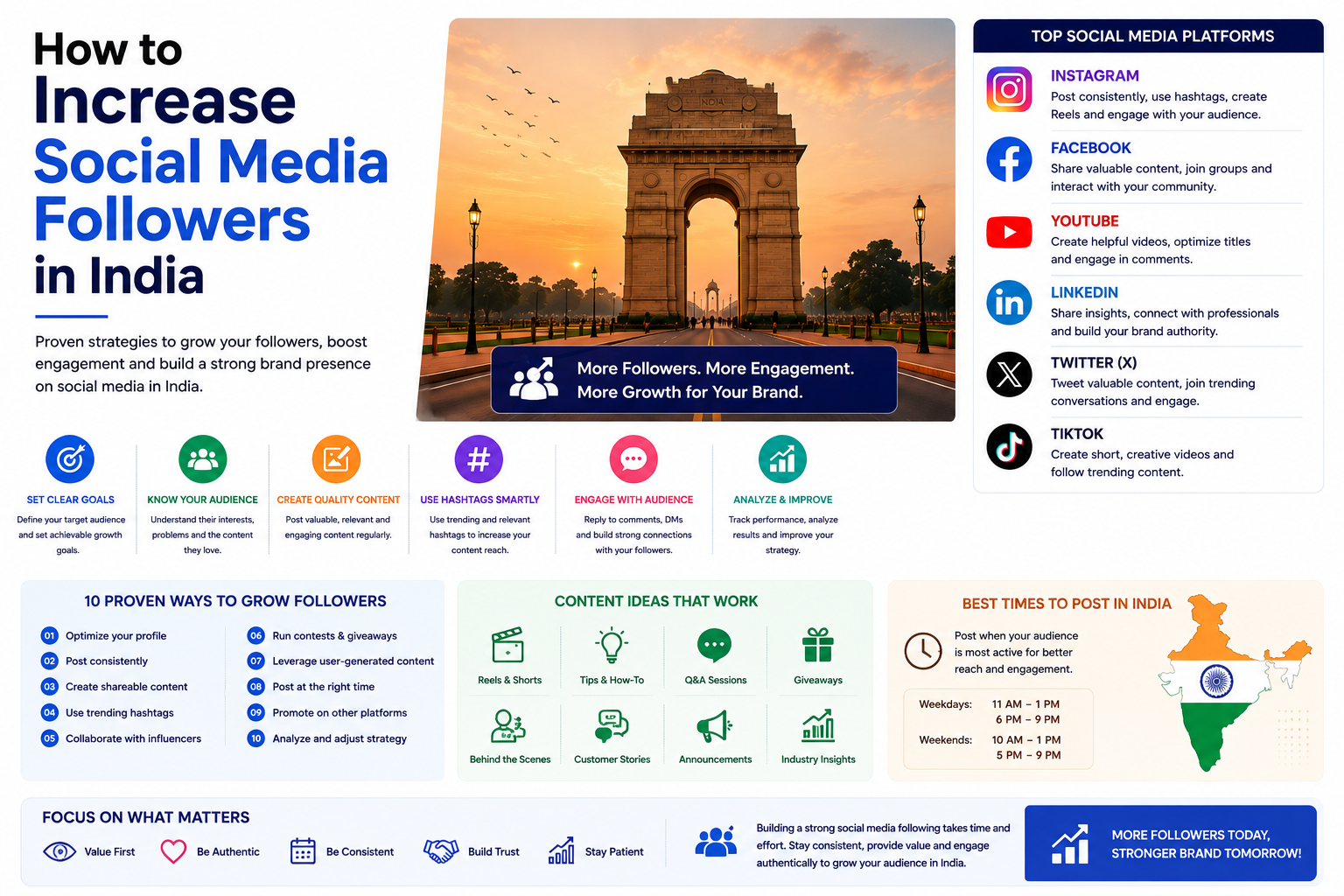
This guide explains how to increase followers, attract real followers, improve discovery, use local languages, work with creators, and measure social media growth across platforms such as Instagram, Facebook, LinkedIn, YouTube, and X.
How Do You Increase Social Media Followers?
To increase social media followers, start with one clearly defined audience.
Then:
- Choose the platforms that audience actually uses.
- Create valuable content around their needs.
- Make your profile easy to understand.
- Participate in relevant conversations.
- Use search-friendly topics.
- Collaborate with suitable creators.
- Review your analytics.
- Repeat what works.
Your goal should not be simply to raise your follower count.
A stronger audience includes engaged followers who may:
- Watch your videos
- Read your posts
- Save useful content
- Share it
- Visit your profile
- Click your website
- Ask questions
- Become customers
India also requires a more localized approach than treating the entire country as one audience. A customer in Jaipur may respond well to Hindi content. A startup founder in Bengaluru may prefer English business content on LinkedIn. A clothing business in Kolkata may use Bengali captions, English product information, and visual content together. The basic growth process can be thought of in five stages.
Discovery
Improve:
- Hooks
- Topic clarity
- Search terms
- Sharing potential
- Relevant trends
Useful signals may include:
- Reach
- Impressions
- Views
Interest
Improve:
- Content quality
- Profile positioning
- Topic relevance
Useful signals may include:
- Profile visits
- Watch time
- Content engagement
Follow
Improve:
- Bio
- Profile clarity
- Content promise
- Pinned content
Useful signal:
- New followers
Trust
Improve:
- Consistency
- Replies
- Customer proof
- Helpful content
Useful signals may include:
- Comments
- Saves
- Shares
- Returning viewers
Action
Improve:
- Offers
- Calls to action
- Website links
- Helpful guidance
Useful signals may include:
- Messages
- Leads
- Website visits
- Sales
Google’s people-first content guidance is designed for Google Search, not social-media algorithms. However, its broader recommendation to create useful content for a real audience is also a useful principle when planning social content.
Why Social Media Follower Growth Matters for Your Brand?
A growing relevant audience gives more people opportunities to become familiar with your business. When people repeatedly encounter useful content from the same brand, they may begin to recognize:
- The company name
- Visual identity
- Products
- Services
- Expertise
- Brand personality
However, the number of followers never tells the full story. A Page with 2,000 relevant and active followers can potentially create more business value than an account with 50,000 followers who rarely interact or care about the offer.
That is why follower growth should be evaluated alongside:
- Engagement
- Profile visits
- Website traffic
- Enquiries
- Leads
- Sales
Think of followers like people entering a shop. A busy entrance may attract attention, but the business still depends on whether visitors are interested in what is inside. For an Indian business, relevant follower growth can also support local discovery.
For example:
- A dentist in Pune can publish simple oral-care advice.
- A home baker in Kochi can showcase regional flavours.
- A software consultant in Hyderabad can explain confusing business tools.
- A fashion store in Jaipur can create festival styling videos.
Each useful post gives potential customers another reason to remember the business.
A follower becomes more valuable when attention develops into trust and trust eventually leads to meaningful action. Strong social proof also comes from more than follower count.
New visitors may look at:
- Customer reviews
- Comments
- Testimonials
- Customer photos
- Regular replies
- Recent content
Together, these signals can make a social media presence feel more established.
Can You Grow Social Media Followers Organically?
Yes.
Organic audience growth can come from:
- Search
- Recommendations
- Sharing
- Useful content
- Community participation
- Collaborations
- Referrals
- Existing customers
An organic follower usually discovers your content, visits your profile, understands what you provide, and chooses to see more. That journey can happen quickly or gradually. Avoid assuming that purchasing followers creates the same kind of audience.
Purchased or irrelevant accounts may contribute little to:
- Views
- Comments
- Shares
- Website visits
- Enquiries
- Sales
They can also make some follower-based engagement calculations less useful because the visible audience becomes less representative of the people actually interacting with the account. A better approach is to run controlled content experiments.
For example:
- Choose several clear topics.
- Publish consistently for a defined testing period.
- Measure profile visits and follows.
- Identify the strongest subjects.
- Create more content around those themes.
Do not treat 30 days as a guaranteed growth period. It is simply a practical testing window you can use to collect initial data.
Comparing Social Media Growth Approaches
Buying followers
Potential result:
- Higher visible numbers without guaranteed audience relevance
Better approach:
- Understand the source and platform rules before considering any third-party engagement service
Follow-for-follow
Potential result:
- Followers who may have little interest in your content
Better approach:
- Focus on people who genuinely match your audience
Official paid promotion
Potential result:
- Additional reach when targeting and creative are effective
Better use:
- Support strong content or a defined campaign objective
Organic publishing
Potential result:
- Gradual audience development around useful content
Better use:
- Build long-term audience relationships
Creator collaborations
Potential result:
- Exposure to another creator’s established audience
Better use:
- Reach relevant communities through suitable partners
Paid advertising can also help businesses reach people in specific Indian locations.
However, more traffic will not solve unclear positioning. When someone visits your account, they should immediately understand why following it is worthwhile.
How to Choose the Right Social Media Platform?
The best platform depends on:
- Audience
- Topic
- Location
- Language
- Content format
- Business objective
Avoid creating accounts on every platform simply because they exist.
A practical starting point may be:
- One primary platform
- One supporting platform
Your platform choice should reflect where your target audience spends time and how they prefer to consume information.
Facebook can be useful for:
- Local businesses
- Communities
- Family-oriented audiences
- Regional-language content
- Business Pages
- Groups
- Videos
A restaurant in Lucknow, for example, could publish a short weekend-menu video and ask customers which dish they prefer. That creates an opportunity for both visibility and conversation. Facebook Groups can also help businesses understand local customer needs.
Instead of immediately promoting your product, first study:
- Frequently asked questions
- Common complaints
- Recommendations
- Local concerns
These conversations can become useful content ideas. Meta provides Page insights that include post reach, engagement, audience information, and actions people take on a Page.
Instagram can suit:
- Visual brands
- Creators
- Food businesses
- Fashion
- Travel
- Coaches
- Designers
- Lifestyle businesses
People may discover Instagram accounts through different surfaces and interactions, so your profile should clearly explain what you provide.
A visitor should quickly understand:
- Who the account is for
- What topics you cover
- Why following is useful
Use local context when appropriate.
For example, a saree brand might create content around:
- Fabric details
- Styling ideas
- Festival looks
- Customer videos
- Care instructions
This gives potential followers more useful reasons to stay than simply publishing product photos.
LinkedIn is particularly relevant for:
- Professionals
- Founders
- Recruiters
- Agencies
- Consultants
- Educators
- B2B companies
Useful LinkedIn content may include:
- Lessons from experience
- Industry observations
- Case studies
- Original data
- Professional opinions
- Practical guides
Avoid relying entirely on generic motivational posts. Specific information is usually more useful.
For example, instead of saying:
Never give up on your startup. A Bengaluru founder could explain: We changed our pricing structure and saw trial sign-ups change. Here are the three things we learned. LinkedIn also provides analytics covering content performance, followers, visitors, search appearances, and other Page data.
TikTok
For India-focused campaigns, TikTok needs an important clarification. As of the latest confirmed public information, TikTok remains blocked in India. The Indian government stated in 2025 that no order had been issued to lift the ban, and the IT minister later said there was no proposal to restore it. More recent reporting available in August 2026 has not established an official relaunch.
For an India-focused marketing strategy, do not plan around TikTok as though it is officially available.
However, many of the creative principles associated with short-form video remain useful on:
- Instagram Reels
- YouTube Shorts
- Facebook Reels
Useful short-video practices include:
- Introduce the topic clearly.
- Keep one main idea.
- Use readable captions.
- Remove unnecessary introductions.
- Show useful information quickly.
The broader lesson is about content creation, not one specific platform.
YouTube
YouTube can support:
- Tutorials
- Reviews
- Interviews
- Demonstrations
- Educational videos
- Long-form explainers
- Shorts
Useful videos can continue attracting viewers through YouTube Search and recommendations after publication. YouTube Analytics also provides reports showing how people discover videos, including YouTube Search terms, suggested videos, external traffic, impressions, views, watch time, and other performance metrics.
Use titles that clearly describe what the video offers. Thumbnails should create interest without misleading the viewer. For multilingual Indian audiences, captions or subtitles can also improve accessibility. YouTube Shorts can introduce people to a topic, while longer videos can provide deeper information.
X
X can be useful for:
- Commentary
- Technology
- Journalism
- Industry discussion
- Customer support
- Real-time conversations
Useful posts may include:
- Clear opinions
- Short explanations
- Relevant observations
- Threads
- Replies to industry discussions
Participation matters. A thoughtful reply can sometimes introduce your expertise more effectively than publishing only promotional posts. Because conversations can move quickly, verify important facts before posting.
1. Define Your Ideal Follower
Before trying to grow your followers, define who you actually want to attract.
“Everyone in India” is too broad.
A stronger audience definition might include:
- Location
- Language
- Age range
- Occupation
- Problem
- Goal
- Budget
- Preferred content format
For example:
I help busy professionals in Mumbai build simple vegetarian meal habits.
That description provides much more direction than:
I post fitness content.
To understand your audience, review:
- Customer messages
- Sales calls
- Reviews
- Competitor comments
- Search suggestions
- Common questions
Questions to Define Your Audience
Location
- Which cities, states, or regions matter?
Language
- Which language feels natural to the audience?
Problem
- What is frustrating them?
Goal
- What result are they trying to achieve?
Budget
- What can they realistically afford?
Format
- Do they prefer video, text, images, or detailed guides?
Trust
- What information do they need before taking action?
These details help you create relevant content instead of attracting people who are unlikely to need what you provide.
2. Create Valuable Content Your Audience Wants
Useful content gives people a reason to stop scrolling.
It may:
- Teach a skill
- Answer a question
- Compare choices
- Explain a process
- Solve a problem
- Entertain
- Provide inspiration
A strong post often has:
- A clear topic.
- A useful promise.
- Evidence, explanation, or an example.
For example:
Before renting a flat in Bengaluru, check these five agreement details.
That immediately explains who the post is for and why it may be useful. Your social media posts should also serve different purposes.
Some can:
- Educate
- Build trust
- Show customer proof
- Introduce your team
- Promote an offer
- Start conversations
Promotional posts have a place, but they do not need to dominate every conversation.
Build Recurring Content Series
Recurring formats can make a profile easier to remember.
Examples:
- Monday Money Mistakes
- One-Minute Hindi Marketing Tips
- Friday Product Breakdown
- Weekly Career Question
A consistent series gives people who follow you an idea of what they can expect next. Good content does not need to shout the loudest. It needs to answer something the audience genuinely cares about.
Use examples from:
- Indian cities
- Prices
- Festivals
- Workplaces
- Daily routines
when they genuinely improve the content.
3. Engage in Relevant Conversations
Publishing is only one part of social media. You should also participate where your audience already communicates.
That might include:
- LinkedIn discussions
- Facebook Groups
- YouTube comments
- Community pages
- Creator discussions
Useful participation means adding something to the conversation. Instead of:
Great post!
you might:
- Add an example
- Answer a question
- Clarify a point
- Offer a useful resource
- Share relevant experience
For example, if someone asks whether a small Indian business should begin with organic content or ads, a marketer could explain the benefits and limitations of both approaches.
That provides value without turning every interaction into a sales pitch. Also pay attention to recurring questions. Those questions can become future content ideas.
4. Optimize Your Content for Social Search
Search is an important discovery feature on several social platforms.
For example:
- YouTube Analytics can show search terms viewers used to find videos.
- LinkedIn Page analytics includes Search Appearances and information about keywords used to find a Page.
Make your topic easy to understand.
Depending on the platform, useful topic information may appear in:
- Profile name
- Bio
- Caption
- Video title
- On-screen text
- Spoken explanation
- Playlist title
For example:
Clear:
Digital marketing tips for small businesses in Pune
Less clear:
You need to know this!
Use location and language terms when they genuinely describe the content.
Examples:
- Hindi personal finance for salaried professionals
- Pune digital marketing tips
- Bengali recipe ideas
- Bengaluru startup advice
Use Hashtags Carefully
Hashtags can provide additional context and discovery opportunities on some platforms.
But they cannot rescue weak content. Use relevant tags instead of adding a large collection of unrelated popular hashtags. Also avoid keyword stuffing. The topic should sound natural to humans first.
5. Use Social Media Trends Strategically
Trends can provide temporary discovery opportunities when they fit your subject.
Before joining one, ask:
- Does my audience care?
- Does this fit my brand?
- Can I add something useful or original?
Examples:
- A chef can adapt a popular format to a regional recipe.
- A SaaS company can use a suitable meme to explain a workplace problem.
- A lawyer can explain a trending legal topic carefully and accurately.
Do not force every trend into your content calendar.
Be especially careful around:
- Politics
- Religion
- Tragedies
- Sensitive community issues
Evergreen educational content can continue providing value after a trend disappears. A balanced strategy can use both timely and evergreen content.
6. Collaborate With Relevant Creators
Creator partnerships can introduce a brand to an audience that already knows the creator.
The biggest creator is not automatically the best partner.
Review:
- Audience relevance
- Location
- Language
- Comments
- Content quality
- Previous brand partnerships
- Brand fit
For example:
- A cookware company might work with a Marathi food creator.
- A study app might collaborate with an educator serving students in Kerala.
- A local travel company might work with a regional travel creator.
Relevance can matter more than raw follower count.
Before beginning a partnership, agree on:
- Deliverables
- Payment
- Deadlines
- Disclosure
- Approval process
- Usage rights
Brands and creators operating in India should also review applicable Advertising Standards Council of India guidance for influencer advertising and disclosure requirements.
7. Build Content People Want to Keep Watching
There is no single universal recommendation formula across Facebook, Instagram, LinkedIn, YouTube, and other platforms. Each platform uses different signals and systems. Instead of trying to reverse-engineer one imaginary “social media algorithm,” focus on audience behaviour.
For video, useful indicators can include:
- Views
- Watch time
- Average view duration
- Completion behaviour
- Shares
- Comments
YouTube, for example, provides metrics such as impressions, views, watch time, average view duration, and “stayed to watch” for Shorts.
Improve Your Opening
Remove unnecessarily long introductions. If your video promises three budgeting tips, start delivering those tips quickly.
For example:
This mistake can make your Instagram growth look healthy when it is not.
That clearly identifies the topic and creates a reason to continue.
Useful formats may include:
- Comparisons
- Checklists
- Myth corrections
- Before-and-after examples
- Demonstrations
- Case studies
Avoid misleading clickbait. YouTube itself notes that high click-through rates combined with low average view duration may indicate clickbait and can be associated with weaker recommendation performance.
8. Give People a Reason to Follow You
Someone can enjoy one post without following the account.
Your profile should answer:
What will I receive if I follow?
State:
- Who you help
- What you publish
- Why it is useful
- How often people can expect relevant content, if you follow a schedule
For example:
Helping Indian freelancers find better clients through practical marketing lessons.
is clearer than:
Digital creator.
Improve Your Profile
Consider:
- Clear profile image
- Specific bio
- Strong pinned content
- Recognizable content themes
- Useful links
- Consistent positioning
Your profile promise should match your actual content. If the bio promises personal-finance education but the recent feed contains mostly unrelated memes, visitors may not know why they should follow.
9. Cross-Promote Your Social Media Content
One strong idea can support several channels.
For example, a detailed YouTube video could become:
- An Instagram Reel
- A LinkedIn post
- An X thread
- An email summary
- A website article
Do not copy and paste everything exactly.
Adapt:
- Opening
- Length
- Design
- Caption
- Call to action
to the platform. You can also connect social media with channels you control, including:
- Website
- Email newsletter
- Permission-based WhatsApp communication
For example, a Jaipur travel company could publish a detailed weekend-trip guide and then create:
- Short destination videos
- A cost-comparison carousel
- An email with booking advice
The idea remains consistent while the presentation changes.
10. Use Analytics to Improve Follower Growth
Analytics helps you understand what people actually respond to. Do not review likes alone.
Depending on the platform, monitor:
- Reach
- Impressions
- Views
- Watch time
- Saves
- Shares
- Profile visits
- Followers
- Website clicks
- Enquiries
Meta Business tools provide Page reach and engagement information, YouTube Analytics shows discovery and watch behaviour, and LinkedIn provides follower, content, visitor, and search analytics.
Look for Patterns
For example:
High reach but few profile visits
The content may be interesting without creating curiosity about the account.
Many profile visits but few follows
Your profile promise may need improvement.
Strong views but weak retention
The topic may attract attention, but the video may lose viewers during delivery.
Lower reach but many saves
The content may be particularly useful to a smaller audience.
Track results by:
- Topic
- Format
- Language
- Length
- Publishing time
Then test a few improvements at a time. Changing everything simultaneously makes it difficult to know what caused the result.
How to Measure Social Media Follower Growth?
Measure audience growth and business value together.
A rising follower count may look encouraging while:
- Website visits remain unchanged
- Enquiries fall
- Sales stay flat
That is why a useful dashboard includes more than follower totals.
Follower Growth Rate
A simple net follower growth-rate calculation is:
Follower Growth Rate = ((New Followers − Lost Followers) ÷ Followers at the Start of the Period) × 100
For example:
If you started with 2,000 followers, gained 300, and lost 50:
((300 − 50) ÷ 2,000) × 100 = 12.5%
Use the same method consistently when comparing periods.
Net Followers
What it tells you:
The overall change in audience size.
Reach
What it tells you:
How widely content was distributed according to the platform’s definition.
Keep in mind that exact definitions differ by platform.
Impressions
What they tell you:
How many times content was displayed according to the platform’s reporting rules.
For example, YouTube defines registered impressions specifically around eligible thumbnail displays, so its impression metric should not be assumed to work identically to every other social platform.
Engagement Rate
What it tells you:
How much interaction content receives relative to a chosen denominator.
Possible denominators include:
- Impressions
- Reach
- Followers
Choose one method and use it consistently when comparing your own performance. LinkedIn, for example, defines its Page content engagement rate using interactions divided by impressions.
Profile Visits
What they tell you:
Whether content encouraged people to learn more about the account.
If many people visit but few follow, review:
- Bio
- Pinned posts
- Visual identity
- Content promise
Website Traffic
What it tells you:
Whether your social audience is moving into channels you control.
Use tracked links where possible.
Conversion Rate
What it tells you:
How many visitors complete a desired action.
That action might be:
- Purchase
- Enquiry
- Booking
- Registration
- Download
- Message
Follower growth becomes much more useful when you can connect it to these business outcomes.
Frequently Asked Questions
How Many Followers Do You Need to Make Money on Social Media?
There is no universal number.
A specialized creator with a relatively small but relevant audience may generate income from:
- Consulting
- Affiliate marketing
- Coaching
- Products
- Services
- Brand partnerships
Meanwhile, another business model may require a much larger audience.
The important question is not only:
How many followers do I have?
Also ask:
Are they relevant to what I offer, and do they take meaningful action?
Is It Better to Post More Often or Focus on Quality?
Focus on useful content first. Then choose a publishing schedule you can realistically maintain. There is no universal posting frequency that guarantees follower growth.
Use your own analytics to decide whether increasing or decreasing frequency improves results.
Do Hashtags Still Help Grow Followers?
Hashtags may support categorization and discovery on some platforms.
Their usefulness depends on:
- Platform
- Topic
- Relevance
- Competition
- Content quality
Use accurate hashtags when they help describe the content. Do not treat them as a guaranteed growth tool.
Why Has My Social Media Reach Dropped?
Reach can change for many reasons, including:
- Audience interest
- Content relevance
- Competition
- Seasonality
- Publishing changes
- Platform changes
- Content performance
Avoid diagnosing the entire account from one post.
Review several pieces of content and compare:
- Watch behaviour
- Shares
- Saves
- Profile visits
- Comments
- Reach
Then test improvements.
How Long Does It Take to Grow Followers Organically?
There is no fixed timeframe.
Growth can differ based on:
- Platform
- Niche
- Audience size
- Competition
- Content quality
- Existing brand recognition
- Collaborations
- Search visibility
Instead of assuming that every strategy needs exactly 60 or 90 days, give your tests enough time and content volume to identify meaningful patterns. Focus on whether your leading indicators are improving.
These may include:
- Reach
- Profile visits
- Returning viewers
- Saves
- Shares
- Relevant enquiries
Follower growth may follow later.
Conclusion: Build Real Social Media Followers Through Trust
To increase social media followers in India, begin with relevance.
- Choose platforms where your audience can actually be reached.
- Define the people you want to help.
- Create content around real questions and problems.
- Participate in conversations instead of simply broadcasting.
- Use trends selectively.
- Collaborate with relevant creators.
- Improve your profile.
- Adapt good ideas for different platforms.
- And most importantly, use analytics to understand what your audience genuinely values.
- Your social media account does not need to look perfect.
It needs to be:
- Useful
- Clear
- Recognizable
- Relevant
- Consistent
Start with one audience, one primary platform, and a small number of clear content themes.
- Publish.
- Listen.
- Measure.
- Improve.
That is a more sustainable way to build an audience, attract real followers, and turn social media attention into meaningful business value.