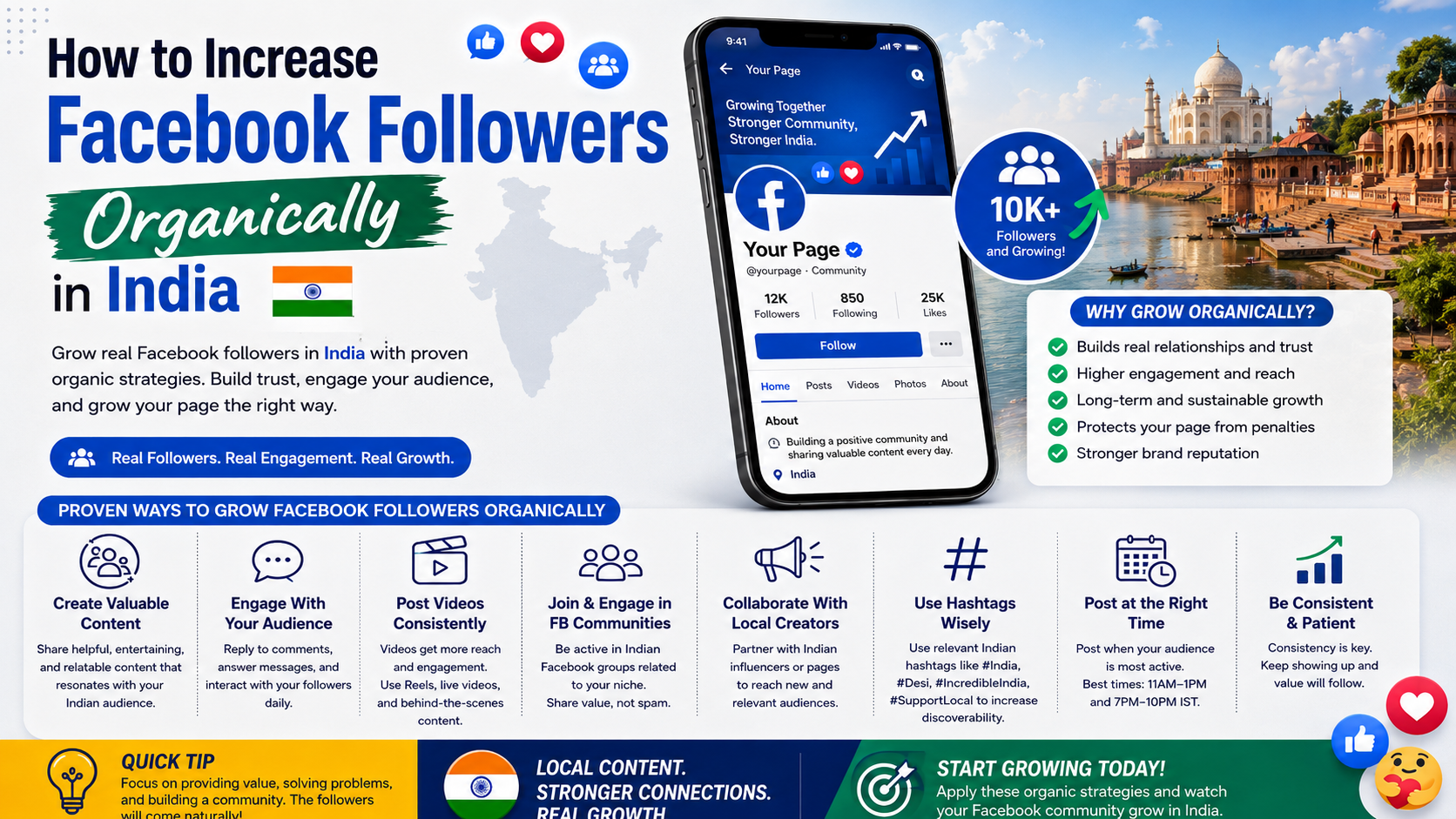
How to Increase Facebook Followers Organically in 2026?
Growing a Facebook audience without buying followers sounds simple. It isn’t always easy. You need useful content, regular interaction, clear branding, and patience. If you’re a creator, shop owner, coach, teacher, freelancer, or local business in India, this guide explains how to get more Facebook followers organically and turn casual visitors into an active community.
The goal isn’t a large number with no value. The goal is to attract people who read your posts, watch your videos, ask questions, share your ideas, and trust your business. That’s the foundation of Facebook organic growth, organic Facebook followers, and steady Facebook audience growth.
What Organic Facebook Growth Really Means?
Facebook organic growth means gaining followers through useful content, conversations, recommendations, shares, search, collaborations, and community activity. You don’t pay for followers. You also don’t use bots, fake accounts, or suspicious engagement services. Instead, you earn attention.
For example, imagine a home baker in Jaipur. She posts simple cake-decoration tips, shows short kitchen videos, answers pricing questions, and shares customer stories. One useful post reaches a local food group. A few people share it. New visitors check her Facebook Page, notice her helpful content, and follow her. That’s organic growth in action. Organic reach can change from day to day. One post might reach 500 people. Another may reach 5,000. This happens because the Facebook algorithm considers factors such as relevance, viewing time, reactions, comments, shares, and the quality of the audience response.
“A small audience that trusts you can create more value than a large audience that ignores you.” If you want to increase Facebook followers, focus on a simple promise. Tell people what they’ll receive when they follow you. It could be affordable recipes, local business advice, exam guidance, fitness tips, regional news, or product education. Be specific. “Useful tips for Indian home businesses” works better than “We provide the best services.”
Organic Facebook Growth vs Paid Campaigns
Paid promotion can increase visibility quickly. However, it doesn’t automatically create loyalty. A promoted post may bring visitors to your page, yet those visitors will follow only when your content feels relevant and trustworthy.
Buying followers creates a bigger problem. Most purchased accounts remain inactive or unrelated to your subject. They don’t comment, share, message, or purchase. Your follower number rises while your Facebook engagement rate falls. That makes performance harder to understand.
- Growth method
- Speed
- Audience quality
- Long-term value
- Main concern
- Organic content
- Moderate
- Usually stronger
- High
- Requires patience
- Paid promotion
- Fast
- Depends on targeting
- Depends on content
- Costs money
- Purchased followers
- Fast on paper
- Usually poor
- Very low
- Damages trust and analytics
A sensible Facebook marketing plan can use both organic and paid methods. Still, your page should first offer useful content, accurate information, and an easy reason to follow. Advertising cannot repair a confusing page. It only sends more people toward the confusion.
How Facebook Reach and Recommendations Affect Growth?
Your followers aren’t the only people who can see your public content. Facebook may show posts, Reels, Stories, and Events to people who don’t follow your Page. Shares, comments, watch time, and recommendations can help your content reach non-followers.
Suppose you publish a short video explaining how small Indian retailers can create a UPI payment QR code. A shop owner shares it with a local business group. Other members watch it, comment, and send it to friends. Facebook receives signals that the video helps people. More viewers may discover it.
That doesn’t mean every post will go viral. Viral promises are usually marketing theatre. Your job is to improve the chance of discovery by making content clear, relevant, watchable, and easy to share.
Use public posts for discovery. Use Stories for regular reminders. Use Groups and Events for community participation. Use Live sessions for deeper interaction. Together, these tools support content distribution, audience interaction, and social media audience growth.
Why Valuable Content Matters More Than Follower Numbers?
People follow pages that make their lives easier, clearer, faster, or more enjoyable. They don’t follow because a page repeatedly asks for likes. They follow because the page gives them a reason to return.
A useful post might explain how to choose a reliable packer in Bengaluru. Another might compare budget smartphones in India. A teacher could explain a difficult mathematics problem in three steps. A salon could share monsoon hair-care advice. These topics work because they answer real questions.
To create valuable content, start with what your audience already asks. Read comments, customer messages, reviews, WhatsApp questions, and discussions in relevant Groups. Your audience is handing you content ideas every day. You only need to notice them.
Numbers still matter. But don’t worship them. A post with 800 views and ten relevant enquiries may be more useful than one with 20,000 views and no action. Track attention and outcomes together.
Build a Facebook Profile or Business Page That Attracts Followers
Before someone follows, they often inspect your profile or Page. They look at your name, photograph, cover image, recent posts, contact details, and description. In a few seconds, they decide whether the page feels active and useful.
If you run a company, create a Facebook Page with an accurate category, clear location, service details, operating hours, and contact options. If you’re a creator or public professional, consider whether Facebook professional mode fits your goals.
A local clothing store in Surat should make its city and product range easy to understand. A freelance designer in Kochi should explain the type of clients served. A Hindi educator should say what learners can expect. Clarity attracts attention.
Optimize Your Facebook Profile for New Visitors
To optimize Facebook profile information, use a recognizable photograph or logo. Choose a simple username. Write a short description that says who you help, what you share, and where you operate.
A strong introduction sounds like this: “Helping Indian small businesses create simple social media content. New tips every Tuesday and Friday.” It tells visitors what to expect.
Add your website, WhatsApp contact, location, services, and relevant links. Then pin a welcome post. That post can explain your purpose, introduce your team, or share your best beginner resource.
If you want to switch to professional mode, review the available settings first. Features can vary by account, location, and Facebook’s current interface. Keep public information accurate. Don’t expose private customer details.
Create a Clear Business Page Identity
Your Page name should match your business identity. Avoid stuffing it with repeated keywords or promotional claims. A name such as “Anaya Homemade Pickles” feels clearer than “Best Cheap Homemade Pickles Online India No. 1.” Use the same logo, colors, tone, and spelling across Facebook, Instagram, your website, packaging, and Google Business Profile.
This improves recognition. Someone who sees your product at a local exhibition should recognize your Page later. Your description should cover four points: what you sell, who you serve, where you operate, and how people can contact you. This structure helps visitors and supports local discovery.
Make Your Bio, Cover Photo, and Page Details Work Together
Think of your profile picture as your signboard. Think of the cover image as your main shop window. Your bio is the person who explains what happens inside. Use the cover image to show a benefit, product category, service area, or community promise. Keep the text readable on mobile screens.
Many Indian users browse through phones, sometimes on slower connections. A complicated graphic becomes a tiny blur. Update details during festivals, seasonal sales, school admissions, monsoon periods, and changes in business hours. Outdated information causes frustration. Frustrated visitors rarely follow.
Create Content That Gives People a Reason to Follow You
Your page needs a content promise. Without one, your posts may feel random. Today, a product offer appears. Tomorrow, a political joke appears. The next day, a copied quote arrives. Visitors become confused. Confused visitors leave.
To understand your target audience, identify their daily problems, goals, interests, concerns, language preferences, and buying habits. India isn’t one single audience. A college student in Delhi, a farmer in Punjab, and a startup founder in Hyderabad may use Facebook differently.
Create three to five content themes. A nutritionist might use affordable meals, myth correction, grocery guidance, client questions, and festival eating tips. A real-estate consultant might discuss documents, locality comparisons, buyer mistakes, rental advice, and home loans.
Share Useful and Original Content Your Audience Actually Wants
When you create original content, add your own experience, examples, images, data, process, or opinion. Don’t simply copy something popular. A copied post might receive temporary attention, but it gives people no reason to remember you.
Try explaining topics through Indian situations. A post about budgeting could mention UPI payments, school fees, rent, fuel costs, and festival spending. A productivity post could address crowded commutes and small home offices. Context makes information feel alive. Use reliable sources for facts. For digital marketing guidance, review resources from the Meta Business Help Center and Meta Business Suite. For Indian business matters, consult official government sources instead of repeating unverified social media claims.
Use Questions and Opinions to Encourage Conversations
Strong questions invite people into a topic. Weak questions feel like homework. Instead of writing “Agree?”, ask, “Which payment method do your customers prefer in 2026: UPI, cash, card, or bank transfer?” Instead of “Tell us your favourite food,” ask, “Which regional breakfast would you recommend to someone visiting your city?”
To encourage conversations, give readers enough context. Then ask one clear question. People respond more easily when they know exactly what you want to discuss. Opinions can attract attention when you explain them fairly. Say why you believe something. Invite different experiences. Avoid attacking people or making reckless claims merely to provoke comments.
Balance Educational, Community, and Promotional Posts
A page that sells in every post quickly feels tiring. People don’t open Facebook to walk through a permanent sales brochure. A flexible starting point can include roughly half educational posts, one-fifth community posts, one-fifth entertaining or relatable posts, and a smaller portion of direct promotions. This isn’t a law.
It’s a useful starting point. Share customer stories, demonstrations, comparisons, behind-the-scenes moments, FAQs, and practical advice. These formats can support sales without shouting. A saree seller might explain fabric care before showing a new collection. A tutor might publish exam tips before offering a course.
Turn Everyday Ideas Into Facebook-Friendly Content
Your daily work contains stories. A mechanic can explain a common vehicle problem. A café can show how it selects coffee beans. A tutor can answer a student’s repeated doubt. A photographer can explain why indoor lighting changes skin tones.
To repurpose existing content, turn one idea into several formats. A blog paragraph can become a short video. A customer question can become a Story poll. A Live answer can become a text post. One useful thought can wear different clothes.
Keep an idea bank on your phone. Add questions, observations, customer comments, seasonal topics, and unusual examples. Creative work becomes easier when you stop expecting inspiration to arrive wearing a tie.
Use Facebook’s Content Formats to Expand Your Reach
Different formats create different kinds of attention. Text posts can explain an opinion. Images can stop scrolling. Videos can demonstrate a process. Stories can maintain daily contact. Live sessions can build trust through real-time exchange.
The best format depends on the message. Don’t turn every idea into a video. Some information needs a simple table. Some stories need a photograph. Some questions work better as polls.
Accessibility matters. Add captions to videos. Use readable text. Keep audio clear. Avoid placing important information only inside an image. Good content should work for people using phones, headphones, low brightness, and limited data.
Images and Visual Posts
To post visual content, use one clear idea per image. Show products, people, locations, processes, results, or real customer situations. Authentic photographs often feel more credible than generic stock pictures.
If you use a graphic, keep the text short. Put the full explanation in the caption. Use strong contrast and large lettering. A beautiful design that nobody can read has become decorative wallpaper.
Carousels and multi-image posts can explain steps, comparisons, checklists, and before-and-after examples. Start with the main benefit. Then guide the reader through the information in a logical order.
Facebook Stories for Frequent Audience Touchpoints
To use Facebook Stories, share quick updates, polls, reminders, product arrivals, appointment openings, customer questions, and informal moments. Stories help followers see that your page remains active.
Keep each frame focused. Add captions because many people watch without sound. Use question stickers when you genuinely want feedback. Don’t publish ten unrelated frames simply because the feature exists.
A local gym might use Stories for a morning exercise tip, a member question, a trainer introduction, and a class reminder. The sequence feels natural. It also gives followers several small reasons to return.
Facebook Live for Real-Time Interaction
Facebook Live works well for tutorials, interviews, demonstrations, launches, Q&A sessions, and community discussions. It creates a less polished but more human experience. Announce the topic in advance. Tell people when it will happen and what they’ll learn. Test your audio and internet connection. A perfect camera cannot rescue sound that resembles a pressure cooker.
During the session, welcome viewers, repeat the topic for late arrivals, answer questions, and explain the next step. Afterward, turn the recording into clips, quotes, FAQs, and follow-up posts.
Events for Community and Business Promotion
Use Facebook Events for workshops, webinars, store openings, exhibitions, local meetups, and online sessions. Include the location, date, time, price, registration link, contact details, and accessibility information.
Promote the Event through Stories, relevant Groups, email, WhatsApp, and partner pages. Avoid flooding people with repeated reminders. Each reminder should offer something new, such as a speaker introduction or useful preparation tip.
After the Event, share photographs with permission. Publish key lessons. Ask attendees what they want next. Community building continues after the chairs get folded.
Short-Form Video and Interactive Content
To create Facebook Reels, focus on one clear idea. Demonstrate a product. Explain a mistake. Compare two options. Answer a question. Show a transformation. Teach a quick skill.
The first few seconds matter. Start with the problem or result. Add subtitles and vertical framing. Keep the background clear. Use original footage whenever possible.
Use polls, quizzes, and question prompts to create social media engagement. Interactive content should collect insight or invite useful participation. Don’t ask people to click buttons for no reason.
Create a Consistent Facebook Posting Routine
A Facebook posting strategy should fit your actual life. If you work alone, planning seven complex videos every week may be fantasy wearing a productivity costume. Start with three to five useful feed posts each week. Add Stories when you have worthwhile updates. Publish short videos when you can maintain quality. Consider one Live or Event each month if it suits your audience.
The right schedule depends on your topic, team, audience, and resources. A news page may publish several times daily. A consultant may publish three thoughtful posts weekly. A local shop may combine product updates with helpful advice.
How Frequently Should You Publish on Facebook?
When people ask, “how often should I post on Facebook to gain followers?” the honest answer is: enough to stay visible, not so much that quality collapses.
A practical starting plan looks like this:
- Format
- Starting frequency
- Feed posts
- 3–5 each week
- Facebook Stories
- 3–7 days each week
- Facebook Reels
- 1–3 each week
- Facebook Live
- Once each month
- Facebook Events
- When genuinely relevant
Treat this as a testing plan. Review performance after four to six weeks. If your audience responds well and production remains manageable, increase carefully. If quality falls, reduce the volume.
Find the Posting Schedule That Fits Your Audience
People often search for “what is the best time to post on Facebook for engagement?” Generic advice can help you begin. Your own data matters more. Check Facebook Insights for periods when followers appear active. Test morning, afternoon, evening, weekday, and weekend slots. Consider Indian Standard Time, audience occupations, school schedules, commuting patterns, and regional differences.
Don’t judge a time from one post. Test several posts with similar goals. Compare Facebook reach, comments, shares, video watch time, profile visits, and follows.
Why Consistency Helps Build Audience Recognition?
When you publish consistently, people remember your themes and visual style. Recurring series also create anticipation. “Monday Money Tip” or “Friday Food Fix” gives your audience a familiar rhythm.
Consistency builds recognition. It doesn’t guarantee success. Weak content published regularly remains weak content, like a loud alarm clock that never solves the problem.
Use a content calendar with themes, formats, dates, captions, visual requirements, links, and review notes. Leave space for timely topics. India’s news cycles, festivals, weather, and regional events can change the week quickly.
Maintain Quality When Increasing Your Posting Frequency
Before adding more posts, check your production process. Can you research accurately? Can you respond to comments? Can you maintain clear visuals and useful captions? To maintain a posting schedule, batch similar tasks. Write several captions together. Record multiple short videos in one session. Prepare reusable design templates. Keep an evergreen content folder for busy days.
Review every post for accuracy, clarity, spelling, accessibility, links, and tone. Don’t publish filler simply to protect a streak.
Increase Facebook Engagement and Turn Viewers Into Followers
Attention becomes a follow when people see repeated value. A visitor may watch one Reel. They may follow after reading three useful posts and seeing thoughtful replies beneath them.
To turn Facebook engagement into followers, make your page promise visible. Pin a welcome post. Use a natural follow request after delivering useful information. Explain what future posts will cover.
A good call to action sounds like this: “Follow this Page for two practical GST tips every week.” It tells people what they’ll receive. “Follow us now” says much less.
Write Posts That Naturally Start Conversations
Begin with a specific problem, observation, story, or useful fact. Then explain the issue briefly. Finally, ask one focused question. “Many small shops lose repeat customers because they reply late to WhatsApp messages. What response time works best for your business?”
This post has context. It invites experience. It can attract comments from relevant people.
To increase post engagement, make your question easy to answer on a phone. Avoid five questions in one caption. People are busy. Their attention has already boarded another train.
Respond to Comments and Continue the Discussion
When you respond to comments, add value. Ask a follow-up question. Clarify a detail. Share a small example. A reply saying “Thanks” is polite. A reply that continues the discussion is useful.
Handle criticism calmly. If a customer shares a genuine problem, acknowledge it publicly and move sensitive details into a private channel. Never publish personal information without permission.
Your comment section can become a searchable library of answers. Repeated questions deserve new posts, Stories, or videos. That is how audience interaction improves content over time.
Encourage Existing Followers to Interact With New Posts
Invite followers to share a post with someone who genuinely needs it. Ask customers for honest experiences. Use polls to include quieter followers. Highlight community contributions with permission.
Don’t ask for likes and comments on every post. Constant requests feel needy. Give people something worth discussing first.
The aim is community building, not noise. A thoughtful comment from the right customer can matter more than dozens of empty reactions.
Build Relationships Beyond Your Own Facebook Page
A Page doesn’t grow in isolation. Relevant Groups, local associations, email lists, websites, WhatsApp communities, partner businesses, and offline networks can introduce your content to new people.
Participate before promoting. Read Group rules. Answer questions without turning every response into an advertisement. People notice who contributes and who arrives only carrying a sales banner.
Promote Your Facebook Presence Without Buying Followers
Use cross-promotion through your website, email signature, packaging, invoices, menus, receipts, QR codes, and WhatsApp Business status. Tell people why they should follow. A café might write, “Follow our Facebook Page for weekend menus and local events.” A tutor might say, “Follow for free weekly revision questions.” The benefit should be clear.
Offline promotion works especially well for Indian local businesses. A QR code beside a billing counter can turn existing customers into followers. Ask only when the Page contains useful, current content.
Share Your Facebook Page Across Your Other Channels
Adapt the message for each platform. Don’t paste the same sentence everywhere. Instagram followers may respond to a Reel invitation. Email subscribers may prefer a link to a detailed Facebook discussion.
Send people to a specific resource. Mention a Live session, Event, guide, customer story, or useful post. A vague “Follow us on Facebook” request lacks urgency and value. Use trackable links where practical. Then compare which channels send engaged visitors rather than simply clicks.
Use Existing Customers and Communities to Expand Reach
Satisfied customers can become trusted advocates. Invite authentic reviews and recommendations. Ask permission before using photographs, messages, or testimonials. Local businesses can work with apartment associations, colleges, clubs, professional groups, and city communities.
A yoga instructor could offer a free posture session for a housing society. A bookstore could host a regional-language reading event. These activities support social media audience growth because they connect online content with real-world trust.
Collaborate With Creators, Businesses, and Relevant Communities
Creator collaboration works best when audiences overlap naturally. A nutritionist could work with a local fitness coach. A wedding photographer could partner with a makeup artist. A tax consultant could collaborate with a small-business educator.
To collaborate with creators, agree on the topic, schedule, roles, disclosures, and follow-up plan. Choose relevance over follower count. A micro-creator with a strong Pune audience may be more useful to a local business than a celebrity with scattered attention.
Create interviews, joint Live sessions, tutorials, comparisons, or community discussions. Each partner should offer something meaningful.
Run Facebook Contests Without Damaging Organic Engagement
Contests can attract attention, but poorly planned contests attract people who want only prizes. Design the activity around your subject and audience.
A regional food brand might ask people to share a family recipe. A bookstore could invite readers to explain their favourite Indian author. A fitness page could run a safe seven-day movement challenge.
Publish clear rules, dates, eligibility, prize details, selection criteria, delivery terms, and privacy information. Follow Facebook’s current promotion requirements and the Facebook Community Standards. Never pressure people to spam friends or create fake activity.
Use Facebook Insights to Improve Your Growth Strategy
Guesswork feels exciting until the numbers disagree. Facebook Insights, Facebook analytics, and Meta Business Suite can help you understand what your audience actually does. Review performance weekly. Look for broader patterns monthly. One poor post doesn’t prove a topic failed. Several weak posts may reveal a problem with the topic, hook, format, timing, or audience fit.
Which Facebook Metrics Should You Track?
Track reach, impressions, comments, shares, video watch time, completion rate, Page visits, profile visits, new followers, unfollows, messages, leads, and sales where relevant.
Your Facebook engagement rate needs a consistent calculation. For example:
Engagement Rate=Reactions + Comments + Shares + ClicksReach×100\text{Engagement Rate} = \frac{\text{Reactions + Comments + Shares + Clicks}}{\text{Reach}} \times 100Engagement Rate=ReachReactions + Comments + Shares + Clicks×100
Different tools may use different formulas. Record your method. Otherwise, monthly comparisons become muddy.
Measure Reach, Engagement, and Follower Growth
To measure organic reach, compare how many people saw your posts without paid distribution. Then examine whether those viewers took meaningful action. If reach is high but follows are low, your page promise may be unclear. If engagement is strong but reach is low, your content may need better distribution. If followers rise but enquiries remain unchanged, your audience may not match your business goal.
Track audience demographics where available. Review age ranges, locations, languages, and audience interests. A page targeting customers in Mumbai should notice if most new followers come from an unrelated region.
Identify Your Best-Performing Content
To identify high-performing content, compare posts by topic, format, opening line, length, visual style, comments, shares, watch time, and follows generated. Don’t look only at reactions. Shares often indicate practical value. Comments may show trust or confusion. Video completion can reveal whether the opening and structure worked.
Keep a small experiment record:
- Test
- What changed
- Result
- Next action
- Reel opening
- Question instead of greeting
- More watch time
- Test more questions
- Caption length
- Shorter explanation
- More comments
- Keep concise
- Posting time
- Evening instead of morning
- Higher reach
- Repeat the test
Turn Audience Data Into Better Content Decisions
Use recurring questions to create content clusters. If people repeatedly ask about business registration, create beginner posts, a checklist, a video explanation, a Live session, and a downloadable guide.
To analyze Facebook performance, test one major change at a time. Change the hook, not the topic and timing and format simultaneously. Otherwise, you won’t know what created the result.
Analytics should guide decisions. They shouldn’t replace judgment. A post about a serious local issue may receive fewer reactions yet serve an important community purpose.
Avoid Facebook Growth Tactics That Hurt Your Reach
Shortcuts often look attractive because they hide the bill. You may pay with poor analytics, low trust, account restrictions, or an audience that never responds. Low-quality posts, copied material, misleading hooks, fake urgency, and automated comments can weaken your page. Repetition also causes fatigue. Your followers don’t need the same sales message wearing three different shirts.
Why Low-Quality or Repetitive Content Can Reduce Engagement?
Blurry visuals, poor audio, vague captions, irrelevant trends, and exaggerated promises give people little reason to stay. When users quickly scroll away, your content receives weaker attention signals.
To improve Facebook reach, focus on relevance first. Make the opening clear. Use original examples. Keep the design readable. Add captions. Answer a genuine question. A content audit every quarter can reveal weak patterns. Remove outdated information. Refresh useful evergreen posts. Stop publishing topics that repeatedly attract the wrong audience.
Common Facebook Engagement Mistakes Businesses Make
Many businesses post only product photos and prices. Others ignore comments, reply days later, or use formal captions that sound like a government circular. Some pages delete every criticism. That can make the comment section look tidy while customer trust quietly leaves through the back door.
Other mistakes include using identical content everywhere, publishing without a schedule, making unsupported claims, and failing to mention location or next steps. Fix the basics before chasing advanced tactics.
Avoid Artificial Follower Growth and Misleading Tactics
Don’t buy followers, likes, comments, or automated reactions. Avoid follow-for-follow schemes and engagement groups filled with unrelated accounts. These methods may inflate visible numbers. They rarely create customers, community members, or genuine advocates. They also make Facebook analytics harder to interpret.
Use strong passwords and two-factor authentication. Review connected apps. Avoid services that request unnecessary account access. Real growth may feel slower. It also has a pulse.
Follow Facebook’s Content and Community Guidelines
Always follow Facebook Community Standards and rules covering spam, intellectual property, harassment, misinformation, regulated products, promotions, privacy, and paid partnerships.
Use original or licensed images, music, and videos. Disclose sponsored relationships clearly. Protect customer information. Obtain permission before publishing identifiable photographs or private messages.
Policies can change. Check Meta’s official Transparency Center before publishing sensitive material. A careful review takes minutes. Recovering a restricted Page can take much longer.
Should You Use Facebook Ads to Grow Your Audience?
Organic methods may be enough for a community-led business, local expert, educator, creator, or niche publisher. You can grow through useful posts, Groups, Events, referrals, partnerships, search, and customer recommendations.
Paid promotion can support discovery when you have a proven post, Event, webinar, lead magnet, or local offer. Use small tests. Target carefully. Judge results by engaged followers, enquiries, registrations, and sales.
When Organic Facebook Growth Is Enough?
If your audience responds well and your budget is limited, continue with organic methods. This works especially well when trust, explanation, and conversation matter. A local doctor, teacher, craft seller, or community organization may benefit from steady educational posts. Their audience often needs repeated exposure before taking action.
However, organic growth can be slower. You need patience and a repeatable system.
When Paid Promotion Can Support Organic Growth?
Use advertising to amplify content that already shows promise. Don’t use ads to hide weak positioning or a neglected Page. A small Indian restaurant could promote an Event within five kilometres. A coaching centre could advertise a free webinar to parents in selected cities. A startup could test which message attracts qualified visitors. Separate paid and organic results. Cheap reach is not automatically useful reach.
How to Combine Content and Advertising Effectively?
Publish content organically first. Review its early response. Promote selected posts with one clear objective. Continue regular organic publishing while the campaign runs. Later, compare paid visitors with organic visitors. Did they follow? Did they watch? Did they message? Did they return?
The best combination creates a feedback loop. Organic content reveals what people care about. Advertising helps selected messages reach more relevant people.
How Long Does It Take to Grow Facebook Followers Organically?
There is no honest universal deadline. Results depend on your niche, starting audience, topic demand, publishing quality, distribution, competition, and consistency. During the first month, you may mostly learn. In months two and three, repeated patterns can appear.
Between months four and six, strong formats and partnerships may create more reliable discovery. Some pages grow faster because a timely topic matches public interest. Measure more than follower count. Look at reach, relevant comments, shares, profile visits, repeat viewers, messages, and enquiries.
Why Sustainable Growth Takes Consistent Effort?
Trust develops through repeated useful experiences. Each strong post becomes another entry point for discovery. Each thoughtful reply shows that a real person manages the page.
To grow an audience organically, create a system you can maintain during busy weeks. Batch content. Keep an idea bank. Use templates. Schedule evergreen posts. Leave room for timely updates.
Growth is rarely a straight line. Some weeks feel quiet. Then one helpful post reaches a local group and opens the door.
What to Do When Your Follower Count Stops Increasing?
Check reach, profile visits, follows, and unfollows separately. Review your recent topics, opening lines, formats, posting times, and calls to action.
Maybe your content attracts viewers but your bio doesn’t explain the Page. Maybe your videos receive views but no one knows what to expect next. Maybe your posts are useful yet invisible outside your current audience.
Refresh the Page promise. Test a new format. Ask followers what they need. Build a creator partnership. Review policy notices. Don’t throw away a good strategy after one slow week.
How to Build Momentum From Small Engagement Wins?
When one post receives relevant comments, create a follow-up quickly. Turn the discussion into a Reel, Story poll, Live topic, or detailed guide.
If people ask about pricing, create a transparent explanation. If they debate two options, publish a comparison. If customers share experiences, create user-generated content (UGC) with permission.
Small wins compound when you repeat the underlying value. Momentum isn’t magic. It’s a series of useful decisions made consistently.
Frequently Asked Questions About Facebook Follower Growth
How Can I Get More Followers on Facebook for Free?
Publish useful original posts, optimize your Page, reply to comments, share your Page through relevant channels, collaborate with aligned creators, and use Reels, Stories, Live sessions, and Events. Avoid buying followers because inactive accounts don’t create meaningful results.
How Do I Grow My Facebook Followers Organically?
Define a clear audience and content promise. Then create valuable content, publish consistently, encourage conversation, respond to comments, and review your analytics. Local examples, regional languages, useful demonstrations, and customer questions can make your posts more relevant in India.
How Can I Gain Facebook Followers Without Paid Ads?
Use cross-promotion through your website, email, WhatsApp, packaging, QR codes, and other social platforms. Participate helpfully in relevant Groups. Create Events. Partner with local businesses. Ask satisfied customers for authentic recommendations.
What Type of Content Attracts Facebook Followers?
Tutorials, explainers, original opinions, checklists, comparisons, short videos, customer stories, local guides, behind-the-scenes posts, and practical answers often attract followers. The best topic depends on your audience. Test formats and study Facebook post engagement rather than copying another Page blindly.
How Often Should I Post on Facebook?
Start with three to five strong feed posts each week. Add Stories several days each week if you have useful updates. Publish Reels when quality remains consistent. A practical Facebook posting schedule is better than random bursts followed by silence.
What Is the Best Time to Post on Facebook?
The best time depends on your audience. Check Facebook Insights and test different Indian Standard Time slots. Compare several posts before deciding. Audience occupation, region, age, and content format can all change the answer.
How Can I Increase Facebook Engagement?
Write specific questions, share useful information, use visual formats, reply to comments, invite experiences, and create follow-up posts from discussions. To increase Facebook Page engagement, give readers a reason to participate before asking for a reaction.
How Do Facebook Reels Help Gain Followers?
Facebook Reels can help you reach new audiences who don’t yet follow your Page. Use a clear opening, vertical video, captions, original footage, useful information, and a simple reason to follow. Views alone don’t guarantee follower growth.
How Can I Grow a Facebook Business Page?
To grow a Facebook Page organically, optimize the Page identity, publish helpful local content, show customer proof, answer questions, collaborate with relevant businesses, use Events, and track Page visits, follows, messages, and enquiries.
How Do I Reach People Who Don’t Follow My Facebook Page?
To reach new audiences, publish public content, create shareable educational posts, use Reels, participate in relevant Groups, collaborate with creators, host Events, and cross-promote through other channels. Keep every distribution method relevant and respectful.
How Do I Check My Facebook Follower Growth?
Use the professional dashboard, Facebook Insights, or Meta Business Suite where available. Review new followers, unfollows, Page visits, reach, engagement, audience locations, and content sources. Record monthly results so short-term fluctuations don’t mislead you.
Which Facebook Metrics Should I Track?
Track organic reach, impressions, engagement rate, comments, shares, watch time, completion rate, profile visits, new followers, unfollows, messages, leads, and conversions. Choose metrics that match your goal. A business should connect Facebook activity with real enquiries or sales.
Does Facebook Professional Mode Help Gain Followers?
Facebook professional mode can help eligible creators publish public content, access professional tools, and build a follower-based audience. It doesn’t replace a clear topic, useful posts, regular replies, and consistent publishing. Feature availability may vary.
Final Takeaway: Build a Facebook Audience That Stays Engaged
The best answer to how to get more Facebook followers organically is not a secret posting hour or a clever trick. It is a useful content system supported by clear branding, real conversations, smart distribution, and regular measurement.
Start by improving your Page or profile. Then create content that solves real problems for Indian viewers. Use photos, videos, Reels, Stories, Live sessions, and Events when they suit the message. Reply to people like neighbours, not statistics.
For the next 30 days, follow a simple routine. Optimize your identity during the first few days. Research audience questions next. Publish three useful posts each week. Add Stories and one short video. Try one collaboration or Event. At the end, use Facebook Insights to find what worked.
That is how to increase Facebook followers naturally while building trust that lasts. Numbers may rise slowly at first. Still, every genuine comment, share, recommendation, and returning visitor strengthens your Facebook audience. And that audience is worth far more than an impressive number that never speaks back.